
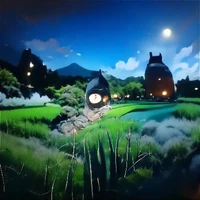
🎥 Qwen-Image-2.1 · Next-Scene LoRA

Feed a frame, direct the next shot. This LoRA teaches Qwen-Image-2.1 cinematic scene continuation: it takes an input image and a director-style instruction and generates the next scene — camera moves, reveals, lighting shifts — while keeping the world, characters and style consistent. Chain outputs into storyboards.
This is the Qwen-Image-2.1 port of the next-scene format pioneered by lovis93/next-scene-qwen-image-lora-2509 (313K downloads on the 2509 edit model) — retrained natively on the newest Qwen image base, where this capability did not exist yet. Companion piece to akhaliq/Qwen-Image-2.1-Multiple-Angles-LoRA (camera control) — together they cover where the camera is and where the story goes next.
Usage
from diffusers import QwenImage21Pipeline
import torch

pipe = QwenImage21Pipeline.from_pretrained("Qwen/Qwen-Image-2.1", torch_dtype=torch.bfloat16)
pipe.load_lora_weights(
    "akhaliq/Qwen-Image-2.1-Next-Scene-LoRA",
    weight_name="next_scene_step2500.safetensors",  # diffusers/ComfyUI-converted
)

image = pipe(
    prompt="Next Scene: The camera pulls back to a sweeping aerial view, "
           "revealing the fleet behind the cliffs. Soft morning light, atmospheric depth.",
    image=input_image,          # your current frame
    num_inference_steps=28,
    true_cfg_scale=1.0,
).images[0]
ComfyUI: load in any Qwen-Image-2.1 workflow with a LoRA node (strength 0.7–0.9), pass your image as the edit/reference input.
Prompt format: start with Next Scene: and lead with the camera direction:
Next Scene: The camera tracks forward and tilts down as rain begins to streak the lens.
Next Scene: Cut to a low-angle shot; sunlight breaks through the clouds behind her.
Next Scene: The camera pans right, revealing the fleet massing behind the ridge.
Pro tips
- Begin with the camera move, then the subject/lighting change — the model was trained on captions written this way.
- Chain generations (output → input) to build sequential storyboards.
- If the output drifts toward copying the input, lower the LoRA strength toward 0.7.
🎬 Next Scene chain — one photo, four directed shots
Starting from a single photograph, each frame is the previous frame's output fed back in with a new director's instruction. Step-2,500 checkpoint, strength 0.7, 40 steps per hop, a grain-breaking blur on chained inputs (see the chaining notes in Scope & limits):

Starting frame: Aldrin Apollo 11 (NASA, public domain). The hops:

- "…pulls back to a wide shot, revealing the vast lunar plain…"
- "…pans right as the astronaut bounds across the regolith, Earth rising over the horizon."
- "Cut to a low-angle shot as the astronaut salutes the flag…"
- "…pushes in on the astronaut's gold visor, the lunar module reflected in the curved glass."
Same world, same astronaut, four directed shots — no video model, just chained edits.
Individual frames: chain/hop_*.jpg.
🎬 Checkpoint sweep (cinematic storm test)
One cinematic starter (generated by the base model), then the same dramatic instruction across checkpoints — "Next Scene: The camera pulls back to an extreme wide shot as a violent storm rolls over the valley, lightning splitting the sky above the ruins, rain sweeping across the frame, the explorer silhouetted against the flash." — 40 steps, strength 0.9, seed 42, plus a no-LoRA control:

Read it row by row: the no-LoRA base already attempts the storm (its editing is strong),
but the trained checkpoints push the transformation much harder — step 2500 rolls a
full storm front over the valley while keeping the explorer, ruins and palette intact.
Individual cells + starter: sweep/.
Which checkpoint
| Checkpoint | Verdict |
|---|---|
next_scene_step2500.safetensors (repo root) |
Recommended. Final step, converted to diffusers key layout. Strongest scene transformation in the sweep (see grid above) while holding composition and identity. |
next_scene_step1500.safetensors |
Softer alternative — moderate transformation, gentler on identity. Try this if 2500 pushes too hard. |
next_scene_step1000.safetensors |
Weakest transformation — mostly for studying the training curve. |
checkpoints/qwen21_next_scene_v1_*.safetensors |
Raw ai-toolkit format — the MLP keys use ai-toolkit's fused naming, which diffusers silently skips. Only use with ai-toolkit/its own loader. (qwen21_next_scene_v1.safetensors = step 2500.) |
Per-250-step sample grids from the training run are in checkpoints/samples/ so the
training curve is inspectable end to end.
Training
- Base: Qwen/Qwen-Image-2.1 (unified generate + edit),
arch: qwen_image_2 - Trainer: ostris/ai-toolkit — rank 64 / alpha 64, adamw8bit, lr 1e-4, weighted timesteps, caption dropout 0.05, 512², 2,500 steps, uint3-quantized base, bf16 training
- Data: 1,144 scene-progression pairs — consecutive frames from the Blender open films Sintel and Tears of Steel (© Blender Foundation, CC-BY, via KevinConnorLee/Sintel (MPI-Sintel frames) and the Blender mirrors). Captions are director-style "Next Scene: …" instructions written by Qwen3-VL-4B over each (frame → next frame) pair. Published: pairs · captioned training set
- Dashboard: trackio training curves
- Demo: akhaliq/qwen21-next-scene
Scope & limits
- Trained on cinematic film frames (one animated, one live-action film) — it generalizes to photographic inputs, but the strongest results are on filmic scenes, landscapes and establishing shots; static portraits are out of scope by design.
- Trained at 512²; larger canvases inherit the behavior but were not trained on.
- Chaining notes (measured, not guessed): naive chaining at strength 0.9 accumulates
film grain into visible color noise by hop 3–4. The verified recipe for clean chains is
strength ≤ 0.7 + a 0.5px gaussian blur on each chained input (breaks the
grain-amplification feedback loop) — the storyboard above is rendered exactly this way,
and the demo Space applies it
automatically. Baseline vs mitigation grids:
chain/vsmitigations/. Late-hop transformations stay conservative — that is a data limitation of v1, not a settings issue. - This is a v1: 1.1K pairs from two films. A v2 with broader footage is the planned upgrade.
- Checkpoint selection here follows the mid-training-peak heuristic from prior
Qwen-Image-2.1 LoRA runs on this trainer; judge
checkpoints/samples/grids and pick your own if you prefer a stronger or lighter bake.
- Downloads last month
- 4,370
Model tree for akhaliq/Qwen-Image-2.1-Next-Scene-LoRA
Base model
Qwen/Qwen-Image-2.1