

problem stringlengths 14 10.4k | solution stringlengths 1 24.1k | answer stringlengths 1 250 ⌀ | problem_is_valid stringclasses 4
values | solution_is_valid stringclasses 3
values | question_type stringclasses 4
values | problem_type stringclasses 8
values | problem_raw stringlengths 14 10.4k | solution_raw stringlengths 1 24.1k | metadata dict |
|---|---|---|---|---|---|---|---|---|---|
Let $x_{1}, x_{2}, \ldots, x_{n}$ be positive real numbers, and let
$$
S=x_{1}+x_{2}+\cdots+x_{n}
$$
Prove that
$$
\left(1+x_{1}\right)\left(1+x_{2}\right) \cdots\left(1+x_{n}\right) \leq 1+S+\frac{S^{2}}{2!}+\frac{S^{3}}{3!}+\cdots+\frac{S^{n}}{n!}
$$ | Let $\sigma_{k}$ be the $k$ th symmetric polynomial, namely
$$
\sigma_{k}=\sum_{\substack{|S|=k \\ S \subseteq\{1,2, \ldots, n\}}} \prod_{i \in S} x_{i},
$$
and more explicitly
$$
\sigma_{1}=S, \quad \sigma_{2}=x_{1} x_{2}+x_{1} x_{3}+\cdots+x_{n-1} x_{n}, \quad \text { and so on. }
$$
Then
$$
\left(1+x_{1}\right)... | proof | Yes | Yes | proof | Inequalities | Let $x_{1}, x_{2}, \ldots, x_{n}$ be positive real numbers, and let
$$
S=x_{1}+x_{2}+\cdots+x_{n}
$$
Prove that
$$
\left(1+x_{1}\right)\left(1+x_{2}\right) \cdots\left(1+x_{n}\right) \leq 1+S+\frac{S^{2}}{2!}+\frac{S^{3}}{3!}+\cdots+\frac{S^{n}}{n!}
$$ | Let $\sigma_{k}$ be the $k$ th symmetric polynomial, namely
$$
\sigma_{k}=\sum_{\substack{|S|=k \\ S \subseteq\{1,2, \ldots, n\}}} \prod_{i \in S} x_{i},
$$
and more explicitly
$$
\sigma_{1}=S, \quad \sigma_{2}=x_{1} x_{2}+x_{1} x_{3}+\cdots+x_{n-1} x_{n}, \quad \text { and so on. }
$$
Then
$$
\left(1+x_{1}\right)... | {
"exam": "APMO",
"problem_label": "1",
"problem_match": "# Problem 1",
"resource_path": "APMO/segmented/en-apmo1989_sol.jsonl",
"solution_match": "# Solution 1",
"tier": "T1",
"year": "1989"
} |
Let $x_{1}, x_{2}, \ldots, x_{n}$ be positive real numbers, and let
$$
S=x_{1}+x_{2}+\cdots+x_{n}
$$
Prove that
$$
\left(1+x_{1}\right)\left(1+x_{2}\right) \cdots\left(1+x_{n}\right) \leq 1+S+\frac{S^{2}}{2!}+\frac{S^{3}}{3!}+\cdots+\frac{S^{n}}{n!}
$$ | By AM-GM,
$$
\left(1+x_{1}\right)\left(1+x_{2}\right) \cdots\left(1+x_{n}\right) \leq\left(\frac{\left(1+x_{1}\right)+\left(1+x_{2}\right)+\cdots+\left(1+x_{n}\right)}{n}\right)^{n}=\left(1+\frac{S}{n}\right)^{n}
$$
By the binomial theorem,
$$
\left(1+\frac{S}{n}\right)^{n}=\sum_{k=0}^{n}\binom{n}{k}\left(\frac{S}{n... | proof | Yes | Yes | proof | Inequalities | Let $x_{1}, x_{2}, \ldots, x_{n}$ be positive real numbers, and let
$$
S=x_{1}+x_{2}+\cdots+x_{n}
$$
Prove that
$$
\left(1+x_{1}\right)\left(1+x_{2}\right) \cdots\left(1+x_{n}\right) \leq 1+S+\frac{S^{2}}{2!}+\frac{S^{3}}{3!}+\cdots+\frac{S^{n}}{n!}
$$ | By AM-GM,
$$
\left(1+x_{1}\right)\left(1+x_{2}\right) \cdots\left(1+x_{n}\right) \leq\left(\frac{\left(1+x_{1}\right)+\left(1+x_{2}\right)+\cdots+\left(1+x_{n}\right)}{n}\right)^{n}=\left(1+\frac{S}{n}\right)^{n}
$$
By the binomial theorem,
$$
\left(1+\frac{S}{n}\right)^{n}=\sum_{k=0}^{n}\binom{n}{k}\left(\frac{S}{n... | {
"exam": "APMO",
"problem_label": "1",
"problem_match": "# Problem 1",
"resource_path": "APMO/segmented/en-apmo1989_sol.jsonl",
"solution_match": "# Solution 2",
"tier": "T1",
"year": "1989"
} |
Prove that the equation
$$
6\left(6 a^{2}+3 b^{2}+c^{2}\right)=5 n^{2}
$$
has no solutions in integers except $a=b=c=n=0$. | We can suppose without loss of generality that $a, b, c, n \geq 0$. Let $(a, b, c, n)$ be a solution with minimum sum $a+b+c+n$. Suppose, for the sake of contradiction, that $a+b+c+n>0$. Since 6 divides $5 n^{2}, n$ is a multiple of 6 . Let $n=6 n_{0}$. Then the equation reduces to
$$
6 a^{2}+3 b^{2}+c^{2}=30 n_{0}^{2... | proof | Yes | Yes | proof | Number Theory | Prove that the equation
$$
6\left(6 a^{2}+3 b^{2}+c^{2}\right)=5 n^{2}
$$
has no solutions in integers except $a=b=c=n=0$. | We can suppose without loss of generality that $a, b, c, n \geq 0$. Let $(a, b, c, n)$ be a solution with minimum sum $a+b+c+n$. Suppose, for the sake of contradiction, that $a+b+c+n>0$. Since 6 divides $5 n^{2}, n$ is a multiple of 6 . Let $n=6 n_{0}$. Then the equation reduces to
$$
6 a^{2}+3 b^{2}+c^{2}=30 n_{0}^{2... | {
"exam": "APMO",
"problem_label": "2",
"problem_match": "# Problem 2",
"resource_path": "APMO/segmented/en-apmo1989_sol.jsonl",
"solution_match": "# Solution\n\n",
"tier": "T1",
"year": "1989"
} |
Let $A_{1}, A_{2}, A_{3}$ be three points in the plane, and for convenience,let $A_{4}=A_{1}, A_{5}=A_{2}$. For $n=1,2$, and 3 , suppose that $B_{n}$ is the midpoint of $A_{n} A_{n+1}$, and suppose that $C_{n}$ is the midpoint of $A_{n} B_{n}$. Suppose that $A_{n} C_{n+1}$ and $B_{n} A_{n+2}$ meet at $D_{n}$, and that ... | Let $G$ be the centroid of triangle $A B C$, and also the intersection point of $A_{1} B_{2}, A_{2} B_{3}$, and $A_{3} B_{1}$ 。
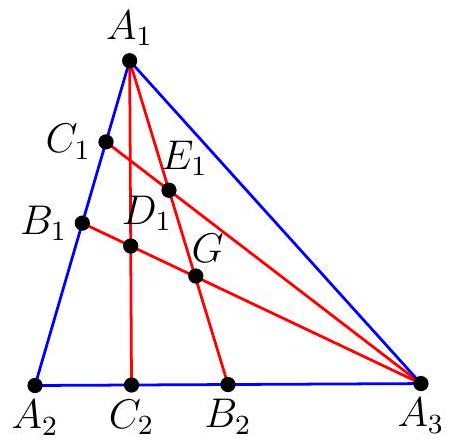
By Menelao's theorem on triangle $B_{1} A_{2} A_{3}$ and line $A... | \frac{25}{49} | Yes | Yes | math-word-problem | Geometry | Let $A_{1}, A_{2}, A_{3}$ be three points in the plane, and for convenience,let $A_{4}=A_{1}, A_{5}=A_{2}$. For $n=1,2$, and 3 , suppose that $B_{n}$ is the midpoint of $A_{n} A_{n+1}$, and suppose that $C_{n}$ is the midpoint of $A_{n} B_{n}$. Suppose that $A_{n} C_{n+1}$ and $B_{n} A_{n+2}$ meet at $D_{n}$, and that ... | Let $G$ be the centroid of triangle $A B C$, and also the intersection point of $A_{1} B_{2}, A_{2} B_{3}$, and $A_{3} B_{1}$ 。

By Menelao's theorem on triangle $B_{1} A_{2} A_{3}$ and line $A... | {
"exam": "APMO",
"problem_label": "3",
"problem_match": "# Problem 3",
"resource_path": "APMO/segmented/en-apmo1989_sol.jsonl",
"solution_match": "\nSolution\n",
"tier": "T1",
"year": "1989"
} |
Let $S$ be a set consisting of $m$ pairs $(a, b)$ of positive integers with the property that $1 \leq a<$ $b \leq n$. Show that there are at least
$$
4 m \frac{\left(m-\frac{n^{2}}{4}\right)}{3 n}
$$
triples $(a, b, c)$ such that $(a, b),(a, c)$, and $(b, c)$ belong to $S$. | Call a triple $(a, b, c)$ good if and only if $(a, b),(a, c)$, and $(b, c)$ all belong to $S$. For $i$ in $\{1,2, \ldots, n\}$, let $d_{i}$ be the number of pairs in $S$ that contain $i$, and let $D_{i}$ be the set of numbers paired with $i$ in $S$ (so $\left|D_{i}\right|=d_{i}$ ). Consider a pair $(i, j) \in S$. Our g... | 4 m \frac{\left(m-\frac{n^{2}}{4}\right)}{3 n} | Yes | Yes | proof | Combinatorics | Let $S$ be a set consisting of $m$ pairs $(a, b)$ of positive integers with the property that $1 \leq a<$ $b \leq n$. Show that there are at least
$$
4 m \frac{\left(m-\frac{n^{2}}{4}\right)}{3 n}
$$
triples $(a, b, c)$ such that $(a, b),(a, c)$, and $(b, c)$ belong to $S$. | Call a triple $(a, b, c)$ good if and only if $(a, b),(a, c)$, and $(b, c)$ all belong to $S$. For $i$ in $\{1,2, \ldots, n\}$, let $d_{i}$ be the number of pairs in $S$ that contain $i$, and let $D_{i}$ be the set of numbers paired with $i$ in $S$ (so $\left|D_{i}\right|=d_{i}$ ). Consider a pair $(i, j) \in S$. Our g... | {
"exam": "APMO",
"problem_label": "4",
"problem_match": "# Problem 4",
"resource_path": "APMO/segmented/en-apmo1989_sol.jsonl",
"solution_match": "# Solution\n\n",
"tier": "T1",
"year": "1989"
} |
Determine all functions $f$ from the reals to the reals for which
(1) $f(x)$ is strictly increasing,
(2) $f(x)+g(x)=2 x$ for all real $x$, where $g(x)$ is the composition inverse function to $f(x)$.
(Note: $f$ and $g$ are said to be composition inverses if $f(g(x))=x$ and $g(f(x))=x$ for all real x.)
Answer: $f(x)=x+c... | Denote by $f_{n}$ the $n$th iterate of $f$, that is, $f_{n}(x)=\underbrace{f(f(\ldots f}_{n \text { times }}(x)))$.
Plug $x \rightarrow f_{n+1}(x)$ in (2): since $g\left(f_{n+1}(x)\right)=g\left(f\left(f_{n}(x)\right)\right)=f_{n}(x)$,
$$
f_{n+2}(x)+f_{n}(x)=2 f_{n+1}(x)
$$
that is,
$$
f_{n+2}(x)-f_{n+1}(x)=f_{n+1}(... | f(x)=x+c | Yes | Yes | math-word-problem | Algebra | Determine all functions $f$ from the reals to the reals for which
(1) $f(x)$ is strictly increasing,
(2) $f(x)+g(x)=2 x$ for all real $x$, where $g(x)$ is the composition inverse function to $f(x)$.
(Note: $f$ and $g$ are said to be composition inverses if $f(g(x))=x$ and $g(f(x))=x$ for all real x.)
Answer: $f(x)=x+c... | Denote by $f_{n}$ the $n$th iterate of $f$, that is, $f_{n}(x)=\underbrace{f(f(\ldots f}_{n \text { times }}(x)))$.
Plug $x \rightarrow f_{n+1}(x)$ in (2): since $g\left(f_{n+1}(x)\right)=g\left(f\left(f_{n}(x)\right)\right)=f_{n}(x)$,
$$
f_{n+2}(x)+f_{n}(x)=2 f_{n+1}(x)
$$
that is,
$$
f_{n+2}(x)-f_{n+1}(x)=f_{n+1}(... | {
"exam": "APMO",
"problem_label": "5",
"problem_match": "# Problem 5",
"resource_path": "APMO/segmented/en-apmo1989_sol.jsonl",
"solution_match": "# Solution\n\n",
"tier": "T1",
"year": "1989"
} |
In $\triangle A B C$, let $D, E, F$ be the midpoints of $B C, A C, A B$ respectively and let $G$ be the centroid of the triangle.
For each value of $\angle B A C$, how many non-similar triangles are there in which $A E G F$ is a cyclic quadrilateral? | Let $I$ be the intersection of $A G$ and $E F$.
Let $\delta=A I . I G-F I$ IE. Then
$$
A I=A D / 2, \quad I G=A D / 6, \quad F I=B C / 4=I E
$$
Further, applying the cosine rule to triangles $A B D, A C D$ we get
$$
\begin{aligned}
A B^{2} & =B C^{2} / 4+A D^{2}-A D \cdot B C \cdot \cos \angle B D A, \\
A C^{2} & =B... | not found | Yes | Yes | math-word-problem | Geometry | In $\triangle A B C$, let $D, E, F$ be the midpoints of $B C, A C, A B$ respectively and let $G$ be the centroid of the triangle.
For each value of $\angle B A C$, how many non-similar triangles are there in which $A E G F$ is a cyclic quadrilateral? | Let $I$ be the intersection of $A G$ and $E F$.
Let $\delta=A I . I G-F I$ IE. Then
$$
A I=A D / 2, \quad I G=A D / 6, \quad F I=B C / 4=I E
$$
Further, applying the cosine rule to triangles $A B D, A C D$ we get
$$
\begin{aligned}
A B^{2} & =B C^{2} / 4+A D^{2}-A D \cdot B C \cdot \cos \angle B D A, \\
A C^{2} & =B... | {
"exam": "APMO",
"problem_label": "1",
"problem_match": "# Question 1 ",
"resource_path": "APMO/segmented/en-apmo1990_sol.jsonl",
"solution_match": "# FIRST SOLUTION\n\n",
"tier": "T1",
"year": "1990"
} |
In $\triangle A B C$, let $D, E, F$ be the midpoints of $B C, A C, A B$ respectively and let $G$ be the centroid of the triangle.
For each value of $\angle B A C$, how many non-similar triangles are there in which $A E G F$ is a cyclic quadrilateral? | (Mr Marcus Brazil, La Trobe University, Bundoora, Melbourne, Australia):
We require, as above,
$$
A I \cdot I G=E I \cdot I F
$$
(which by (1) is equivalent to $A D^{2} / 3=C D^{2}$, i.e. $A D=C D \cdot \sqrt{3}$ ).
Let, without loss of generality, $C D=1$. Then $A$ lies on the circle of radius $\sqrt{3}$ with centre... | 2 | Yes | Yes | math-word-problem | Geometry | In $\triangle A B C$, let $D, E, F$ be the midpoints of $B C, A C, A B$ respectively and let $G$ be the centroid of the triangle.
For each value of $\angle B A C$, how many non-similar triangles are there in which $A E G F$ is a cyclic quadrilateral? | (Mr Marcus Brazil, La Trobe University, Bundoora, Melbourne, Australia):
We require, as above,
$$
A I \cdot I G=E I \cdot I F
$$
(which by (1) is equivalent to $A D^{2} / 3=C D^{2}$, i.e. $A D=C D \cdot \sqrt{3}$ ).
Let, without loss of generality, $C D=1$. Then $A$ lies on the circle of radius $\sqrt{3}$ with centre... | {
"exam": "APMO",
"problem_label": "1",
"problem_match": "# Question 1 ",
"resource_path": "APMO/segmented/en-apmo1990_sol.jsonl",
"solution_match": "\nSECOND SOLUTION ",
"tier": "T1",
"year": "1990"
} |
In $\triangle A B C$, let $D, E, F$ be the midpoints of $B C, A C, A B$ respectively and let $G$ be the centroid of the triangle.
For each value of $\angle B A C$, how many non-similar triangles are there in which $A E G F$ is a cyclic quadrilateral? | in the figure as shown below, we first show that it is necessary that $\angle A$ is less than $90^{\circ}$ if the quadrilateral $A E G F$ ; cyclic.
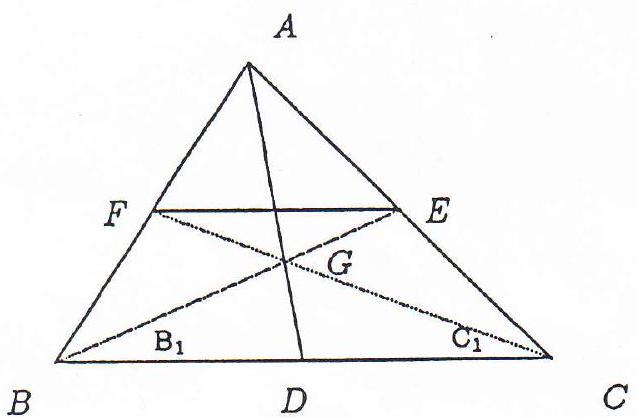
Now, since $E F \| B C$, we get
$$
\begin{... | 0<\alpha \leq 60^{\circ} | Yes | Yes | math-word-problem | Geometry | In $\triangle A B C$, let $D, E, F$ be the midpoints of $B C, A C, A B$ respectively and let $G$ be the centroid of the triangle.
For each value of $\angle B A C$, how many non-similar triangles are there in which $A E G F$ is a cyclic quadrilateral? | in the figure as shown below, we first show that it is necessary that $\angle A$ is less than $90^{\circ}$ if the quadrilateral $A E G F$ ; cyclic.

Now, since $E F \| B C$, we get
$$
\begin{... | {
"exam": "APMO",
"problem_label": "1",
"problem_match": "# Question 1 ",
"resource_path": "APMO/segmented/en-apmo1990_sol.jsonl",
"solution_match": "\nTHIRD SOLUTION\n",
"tier": "T1",
"year": "1990"
} |
Let $a_{1}, a_{2}, \ldots, a_{n}$ be positive real numbers, and let $S_{k}$ be the sum of products of $a_{1}, a_{2}, \ldots, a_{n}$ taken $k$ at a time.
Show that
$$
S_{k} S_{n-k} \geq\binom{ n}{k}^{2} a_{1} a_{2} \ldots a_{n}, \quad \text { for } \quad k=1,2, \ldots, n-1
$$ | $$
\binom{n}{k} a_{1} a_{2} \ldots a_{n}
$$
$2=\sum_{1 \leq i_{1}<i_{2}<\ldots<i_{k} \leq n} a_{i_{1}} a_{i_{2}} \ldots a_{i_{k}} \cdot a_{1} a_{2} \ldots a_{n} / a_{i_{1}} a_{i_{2}} \ldots a_{i_{k}}$
(and using the Cauchy-Schwarz inequality)
$$
\begin{aligned}
& \leq\left(\sum_{1 \leq i_{1}<i_{2}<\ldots<i_{k} \leq n... | proof | Yes | Yes | proof | Inequalities | Let $a_{1}, a_{2}, \ldots, a_{n}$ be positive real numbers, and let $S_{k}$ be the sum of products of $a_{1}, a_{2}, \ldots, a_{n}$ taken $k$ at a time.
Show that
$$
S_{k} S_{n-k} \geq\binom{ n}{k}^{2} a_{1} a_{2} \ldots a_{n}, \quad \text { for } \quad k=1,2, \ldots, n-1
$$ | $$
\binom{n}{k} a_{1} a_{2} \ldots a_{n}
$$
$2=\sum_{1 \leq i_{1}<i_{2}<\ldots<i_{k} \leq n} a_{i_{1}} a_{i_{2}} \ldots a_{i_{k}} \cdot a_{1} a_{2} \ldots a_{n} / a_{i_{1}} a_{i_{2}} \ldots a_{i_{k}}$
(and using the Cauchy-Schwarz inequality)
$$
\begin{aligned}
& \leq\left(\sum_{1 \leq i_{1}<i_{2}<\ldots<i_{k} \leq n... | {
"exam": "APMO",
"problem_label": "2",
"problem_match": "# Question 2",
"resource_path": "APMO/segmented/en-apmo1990_sol.jsonl",
"solution_match": "# FIRST SOLUTION\n\n",
"tier": "T1",
"year": "1990"
} |
Let $a_{1}, a_{2}, \ldots, a_{n}$ be positive real numbers, and let $S_{k}$ be the sum of products of $a_{1}, a_{2}, \ldots, a_{n}$ taken $k$ at a time.
Show that
$$
S_{k} S_{n-k} \geq\binom{ n}{k}^{2} a_{1} a_{2} \ldots a_{n}, \quad \text { for } \quad k=1,2, \ldots, n-1
$$ | (provided by the Canadian Problems Committee).
Write $S_{k}$ as $\sum_{i=1}^{\binom{n}{k}} t_{i}$. Then
주
$$
S_{n-k}=\left(\prod_{m=1}^{n} a_{m}\right)\left(\sum_{i=1}^{\binom{n}{k}} \frac{1}{t_{i}}\right)
$$
$$
\text { so that } \left.\begin{array}{rl}
S_{k} S_{n-k} & =\left(\prod_{m=1}^{n} a_{m}\right) \cdot\left(\... | proof | Yes | Incomplete | proof | Inequalities | Let $a_{1}, a_{2}, \ldots, a_{n}$ be positive real numbers, and let $S_{k}$ be the sum of products of $a_{1}, a_{2}, \ldots, a_{n}$ taken $k$ at a time.
Show that
$$
S_{k} S_{n-k} \geq\binom{ n}{k}^{2} a_{1} a_{2} \ldots a_{n}, \quad \text { for } \quad k=1,2, \ldots, n-1
$$ | (provided by the Canadian Problems Committee).
Write $S_{k}$ as $\sum_{i=1}^{\binom{n}{k}} t_{i}$. Then
주
$$
S_{n-k}=\left(\prod_{m=1}^{n} a_{m}\right)\left(\sum_{i=1}^{\binom{n}{k}} \frac{1}{t_{i}}\right)
$$
$$
\text { so that } \left.\begin{array}{rl}
S_{k} S_{n-k} & =\left(\prod_{m=1}^{n} a_{m}\right) \cdot\left(\... | {
"exam": "APMO",
"problem_label": "2",
"problem_match": "# Question 2",
"resource_path": "APMO/segmented/en-apmo1990_sol.jsonl",
"solution_match": "\nSECOND SOLUTION ",
"tier": "T1",
"year": "1990"
} |
Consider all the triangles $A B C$ which have a fixed base $A B$ and whose altitude from $C$ is a constant $h$. For which of these triangles is the product of its altitudes a maximum? | Let $h_{a}$ and $h_{b}$ be the altitudes from $A$ and $B$, respectively. Then
$$
\begin{aligned}
A B \cdot h \cdot A C \cdot h_{b} \cdot B C \cdot h_{a} & =8 . \text { area of } \triangle A B C)^{3} \\
& =(A B \cdot h)^{3},
\end{aligned}
$$
园
which is a constant. So the product $h . h_{a} \cdot h_{b}$ attains its max... | not found | Yes | Incomplete | math-word-problem | Geometry | Consider all the triangles $A B C$ which have a fixed base $A B$ and whose altitude from $C$ is a constant $h$. For which of these triangles is the product of its altitudes a maximum? | Let $h_{a}$ and $h_{b}$ be the altitudes from $A$ and $B$, respectively. Then
$$
\begin{aligned}
A B \cdot h \cdot A C \cdot h_{b} \cdot B C \cdot h_{a} & =8 . \text { area of } \triangle A B C)^{3} \\
& =(A B \cdot h)^{3},
\end{aligned}
$$
园
which is a constant. So the product $h . h_{a} \cdot h_{b}$ attains its max... | {
"exam": "APMO",
"problem_label": "3",
"problem_match": "# Question 3",
"resource_path": "APMO/segmented/en-apmo1990_sol.jsonl",
"solution_match": "# SOLUTION:",
"tier": "T1",
"year": "1990"
} |
A set of 1990 persons is divided into non-intersecting subsets in such a way that
(a) no one in a subset knows all the others in the subset;
(b) among any three persons in a subset, there are always at least two who do not know each other; and
(c) for any two persons in a subset who do not know each other, there is exa... | (i) Let $S$ be a subset of persons satisfying conditions (a), (b) and (c). Let $x \in S$ be one who knows the maximum number of persons in $S$.
Assume that $x$ knows $x_{1}, x_{2}, \ldots, x_{n}$. By (b), $x_{i}$ and $x_{j}$ are strangers if $i \neq j$. For each $x_{i}$, let $N_{i}$ be the set of persons in $S$ who kno... | 398 | Yes | Yes | proof | Combinatorics | A set of 1990 persons is divided into non-intersecting subsets in such a way that
(a) no one in a subset knows all the others in the subset;
(b) among any three persons in a subset, there are always at least two who do not know each other; and
(c) for any two persons in a subset who do not know each other, there is exa... | (i) Let $S$ be a subset of persons satisfying conditions (a), (b) and (c). Let $x \in S$ be one who knows the maximum number of persons in $S$.
Assume that $x$ knows $x_{1}, x_{2}, \ldots, x_{n}$. By (b), $x_{i}$ and $x_{j}$ are strangers if $i \neq j$. For each $x_{i}$, let $N_{i}$ be the set of persons in $S$ who kno... | {
"exam": "APMO",
"problem_label": "4",
"problem_match": "# Question 4",
"resource_path": "APMO/segmented/en-apmo1990_sol.jsonl",
"solution_match": "# SOLUTION:",
"tier": "T1",
"year": "1990"
} |
Show that for every integer $n \geq 6$, there exists a convex hexagon which can be dissected into exactly $n$ congruent triangles. | (provided by the Canadian Problems Committee).
The basic building blocks will be right angled triangles with sides $p, q$ (which are positive integers) adjacent to the right angle.
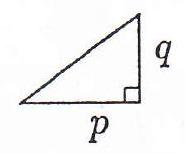
In the fir... | proof | Yes | Yes | proof | Geometry | Show that for every integer $n \geq 6$, there exists a convex hexagon which can be dissected into exactly $n$ congruent triangles. | (provided by the Canadian Problems Committee).
The basic building blocks will be right angled triangles with sides $p, q$ (which are positive integers) adjacent to the right angle.

In the fir... | {
"exam": "APMO",
"problem_label": "5",
"problem_match": "# Question 5",
"resource_path": "APMO/segmented/en-apmo1990_sol.jsonl",
"solution_match": "\nFIRST SOLUTION ",
"tier": "T1",
"year": "1990"
} |
Show that for every integer $n \geq 6$, there exists a convex hexagon which can be dissected into exactly $n$ congruent triangles. | (provided by the Canadian Problems Committee):
The basic building blocks will be right angled triangles with sides $m, n$ (which are positive integers) adjacent to the right angle.
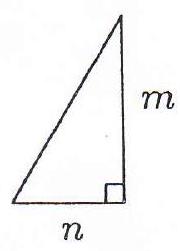
We constru... | proof | Yes | Yes | proof | Geometry | Show that for every integer $n \geq 6$, there exists a convex hexagon which can be dissected into exactly $n$ congruent triangles. | (provided by the Canadian Problems Committee):
The basic building blocks will be right angled triangles with sides $m, n$ (which are positive integers) adjacent to the right angle.

We constru... | {
"exam": "APMO",
"problem_label": "5",
"problem_match": "# Question 5",
"resource_path": "APMO/segmented/en-apmo1990_sol.jsonl",
"solution_match": "\nSECOND SOLUTION ",
"tier": "T1",
"year": "1990"
} |
Let $G$ be the centroid of triangle $A B C$ and $M$ be the midpoint of $B C$. Let $X$ be on $A B$ and $Y$ on $A C$ such that the points $X, Y$, and $G$ are collinear and $X Y$ and $B C$ are parallel. Suppose that $X C$ and $G B$ intersect at $Q$ and $Y B$ and $G C$ intersect at $P$. Show that triangle $M P Q$ is simila... | Let $R$ be the midpoint of $A C$; so $B R$ is a median and contains the centroid $G$.
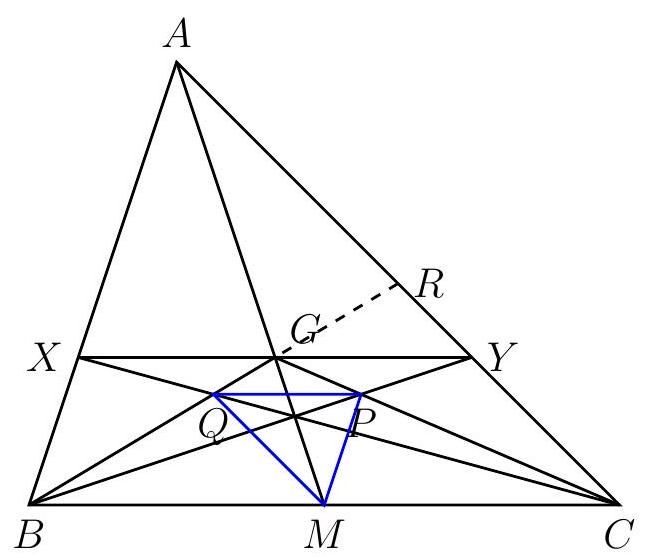
It is well known that $\frac{A G}{A M}=\frac{2}{3}$; thus the ratio of the similarity between $A X Y$ and ... | proof | Yes | Yes | proof | Geometry | Let $G$ be the centroid of triangle $A B C$ and $M$ be the midpoint of $B C$. Let $X$ be on $A B$ and $Y$ on $A C$ such that the points $X, Y$, and $G$ are collinear and $X Y$ and $B C$ are parallel. Suppose that $X C$ and $G B$ intersect at $Q$ and $Y B$ and $G C$ intersect at $P$. Show that triangle $M P Q$ is simila... | Let $R$ be the midpoint of $A C$; so $B R$ is a median and contains the centroid $G$.

It is well known that $\frac{A G}{A M}=\frac{2}{3}$; thus the ratio of the similarity between $A X Y$ and ... | {
"exam": "APMO",
"problem_label": "1",
"problem_match": "# Problem 1",
"resource_path": "APMO/segmented/en-apmo1991_sol.jsonl",
"solution_match": "# Solution 1",
"tier": "T1",
"year": "1991"
} |
Let $G$ be the centroid of triangle $A B C$ and $M$ be the midpoint of $B C$. Let $X$ be on $A B$ and $Y$ on $A C$ such that the points $X, Y$, and $G$ are collinear and $X Y$ and $B C$ are parallel. Suppose that $X C$ and $G B$ intersect at $Q$ and $Y B$ and $G C$ intersect at $P$. Show that triangle $M P Q$ is simila... | Let $S$ and $R$ be the midpoints of $A B$ and $A C$, respectively. Since $G$ is the centroid, it lies in the medians $B R$ and $C S$.
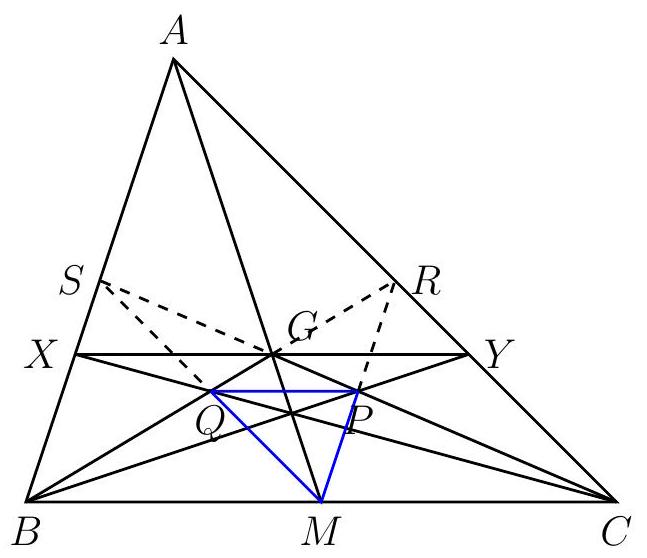
Due to the similarity between triangles $Q B C$ and $Q G ... | proof | Yes | Yes | proof | Geometry | Let $G$ be the centroid of triangle $A B C$ and $M$ be the midpoint of $B C$. Let $X$ be on $A B$ and $Y$ on $A C$ such that the points $X, Y$, and $G$ are collinear and $X Y$ and $B C$ are parallel. Suppose that $X C$ and $G B$ intersect at $Q$ and $Y B$ and $G C$ intersect at $P$. Show that triangle $M P Q$ is simila... | Let $S$ and $R$ be the midpoints of $A B$ and $A C$, respectively. Since $G$ is the centroid, it lies in the medians $B R$ and $C S$.

Due to the similarity between triangles $Q B C$ and $Q G ... | {
"exam": "APMO",
"problem_label": "1",
"problem_match": "# Problem 1",
"resource_path": "APMO/segmented/en-apmo1991_sol.jsonl",
"solution_match": "# Solution 2",
"tier": "T1",
"year": "1991"
} |
Suppose there are 997 points given in a plane. If every two points are joined by a line segment with its midpoint coloured in red, show that there are at least 1991 red points in the plane. Can you find a special case with exactly 1991 red points? | Embed the points in the cartesian plane such that no two points have the same $y$-coordinate. Let $P_{1}, P_{2}, \ldots, P_{997}$ be the points and $y_{1}<y_{2}<\ldots<y_{997}$ be their respective $y$-coordinates. Then the $y$-coordinate of the midpoint of $P_{i} P_{i+1}, i=1,2, \ldots, 996$ is $\frac{y_{i}+y_{i+1}}{2}... | 1991 | Yes | Yes | proof | Combinatorics | Suppose there are 997 points given in a plane. If every two points are joined by a line segment with its midpoint coloured in red, show that there are at least 1991 red points in the plane. Can you find a special case with exactly 1991 red points? | Embed the points in the cartesian plane such that no two points have the same $y$-coordinate. Let $P_{1}, P_{2}, \ldots, P_{997}$ be the points and $y_{1}<y_{2}<\ldots<y_{997}$ be their respective $y$-coordinates. Then the $y$-coordinate of the midpoint of $P_{i} P_{i+1}, i=1,2, \ldots, 996$ is $\frac{y_{i}+y_{i+1}}{2}... | {
"exam": "APMO",
"problem_label": "2",
"problem_match": "# Problem 2",
"resource_path": "APMO/segmented/en-apmo1991_sol.jsonl",
"solution_match": "# Solution\n\n",
"tier": "T1",
"year": "1991"
} |
Let $a_{1}, a_{2}, \ldots, a_{n}, b_{1}, b_{2}, \ldots, b_{n}$ be positive real numbers such that $a_{1}+a_{2}+\cdots+a_{n}=b_{1}+b_{2}+$ $\cdots+b_{n}$. Show that
$$
\frac{a_{1}^{2}}{a_{1}+b_{1}}+\frac{a_{2}^{2}}{a_{2}+b_{2}}+\cdots+\frac{a_{n}^{2}}{a_{n}+b_{n}} \geq \frac{a_{1}+a_{2}+\cdots+a_{n}}{2}
$$ | By the Cauchy-Schwartz inequality,
$$
\left(\frac{a_{1}^{2}}{a_{1}+b_{1}}+\frac{a_{2}^{2}}{a_{2}+b_{2}}+\cdots+\frac{a_{n}^{2}}{a_{n}+b_{n}}\right)\left(\left(a_{1}+b_{1}\right)+\left(a_{2}+b_{2}\right)+\cdots+\left(a_{n}+b_{n}\right)\right) \geq\left(a_{1}+a_{2}+\cdots+a_{n}\right)^{2} .
$$
Since $\left(\left(a_{1}+... | proof | Yes | Yes | proof | Inequalities | Let $a_{1}, a_{2}, \ldots, a_{n}, b_{1}, b_{2}, \ldots, b_{n}$ be positive real numbers such that $a_{1}+a_{2}+\cdots+a_{n}=b_{1}+b_{2}+$ $\cdots+b_{n}$. Show that
$$
\frac{a_{1}^{2}}{a_{1}+b_{1}}+\frac{a_{2}^{2}}{a_{2}+b_{2}}+\cdots+\frac{a_{n}^{2}}{a_{n}+b_{n}} \geq \frac{a_{1}+a_{2}+\cdots+a_{n}}{2}
$$ | By the Cauchy-Schwartz inequality,
$$
\left(\frac{a_{1}^{2}}{a_{1}+b_{1}}+\frac{a_{2}^{2}}{a_{2}+b_{2}}+\cdots+\frac{a_{n}^{2}}{a_{n}+b_{n}}\right)\left(\left(a_{1}+b_{1}\right)+\left(a_{2}+b_{2}\right)+\cdots+\left(a_{n}+b_{n}\right)\right) \geq\left(a_{1}+a_{2}+\cdots+a_{n}\right)^{2} .
$$
Since $\left(\left(a_{1}+... | {
"exam": "APMO",
"problem_label": "3",
"problem_match": "# Problem 3",
"resource_path": "APMO/segmented/en-apmo1991_sol.jsonl",
"solution_match": "# Solution\n\n",
"tier": "T1",
"year": "1991"
} |
During a break, $n$ children at school sit in a circle around their teacher to play a game. The teacher walks clockwise close to the children and hands out candies to some of them according to the following rule. He selects one child and gives him a candy, then he skips the next child and gives a candy to the next one,... | Number the children from 0 to $n-1$. Then the teacher hands candy to children in positions $f(x)=1+2+\cdots+x \bmod n=\frac{x(x+1)}{2} \bmod n$. Our task is to find the range of $f: \mathbb{Z}_{n} \rightarrow \mathbb{Z}_{n}$, and to verify whether the range is $\mathbb{Z}_{n}$, that is, whether $f$ is a bijection.
If $... | All\ powers\ of\ 2 | Yes | Yes | math-word-problem | Number Theory | During a break, $n$ children at school sit in a circle around their teacher to play a game. The teacher walks clockwise close to the children and hands out candies to some of them according to the following rule. He selects one child and gives him a candy, then he skips the next child and gives a candy to the next one,... | Number the children from 0 to $n-1$. Then the teacher hands candy to children in positions $f(x)=1+2+\cdots+x \bmod n=\frac{x(x+1)}{2} \bmod n$. Our task is to find the range of $f: \mathbb{Z}_{n} \rightarrow \mathbb{Z}_{n}$, and to verify whether the range is $\mathbb{Z}_{n}$, that is, whether $f$ is a bijection.
If $... | {
"exam": "APMO",
"problem_label": "4",
"problem_match": "# Problem 4",
"resource_path": "APMO/segmented/en-apmo1991_sol.jsonl",
"solution_match": "# Solution 1",
"tier": "T1",
"year": "1991"
} |
During a break, $n$ children at school sit in a circle around their teacher to play a game. The teacher walks clockwise close to the children and hands out candies to some of them according to the following rule. He selects one child and gives him a candy, then he skips the next child and gives a candy to the next one,... | We give a full description of $a_{n}$, the size of the range of $f$.
Since congruences modulo $n$ are defined, via Chinese Remainder Theorem, by congruences modulo $p^{\alpha}$ for all prime divisors $p$ of $n$ and $\alpha$ being the number of factors $p$ in the factorization of $n, a_{n}=\prod_{p^{\alpha} \| n} a_{p^{... | All\ powers\ of\ 2 | Yes | Yes | math-word-problem | Number Theory | During a break, $n$ children at school sit in a circle around their teacher to play a game. The teacher walks clockwise close to the children and hands out candies to some of them according to the following rule. He selects one child and gives him a candy, then he skips the next child and gives a candy to the next one,... | We give a full description of $a_{n}$, the size of the range of $f$.
Since congruences modulo $n$ are defined, via Chinese Remainder Theorem, by congruences modulo $p^{\alpha}$ for all prime divisors $p$ of $n$ and $\alpha$ being the number of factors $p$ in the factorization of $n, a_{n}=\prod_{p^{\alpha} \| n} a_{p^{... | {
"exam": "APMO",
"problem_label": "4",
"problem_match": "# Problem 4",
"resource_path": "APMO/segmented/en-apmo1991_sol.jsonl",
"solution_match": "# Solution 2",
"tier": "T1",
"year": "1991"
} |
Given are two tangent circles and a point $P$ on their common tangent perpendicular to the lines joining their centres. Construct with ruler and compass all the circles that are tangent to these two circles and pass through the point $P$. | Throughout this problem, we will assume that the given circles are externally tangent, since the problem does not have a solution otherwise.
Let $\Gamma_{1}$ and $\Gamma_{2}$ be the given circles and $T$ be their tangency point. Suppose $\omega$ is a circle that is tangent to $\Gamma_{1}$ and $\Gamma_{2}$ and passes th... | not found | Yes | Yes | math-word-problem | Geometry | Given are two tangent circles and a point $P$ on their common tangent perpendicular to the lines joining their centres. Construct with ruler and compass all the circles that are tangent to these two circles and pass through the point $P$. | Throughout this problem, we will assume that the given circles are externally tangent, since the problem does not have a solution otherwise.
Let $\Gamma_{1}$ and $\Gamma_{2}$ be the given circles and $T$ be their tangency point. Suppose $\omega$ is a circle that is tangent to $\Gamma_{1}$ and $\Gamma_{2}$ and passes th... | {
"exam": "APMO",
"problem_label": "5",
"problem_match": "# Problem 5",
"resource_path": "APMO/segmented/en-apmo1991_sol.jsonl",
"solution_match": "# Solution\n\n",
"tier": "T1",
"year": "1991"
} |
A triangle with sides $a, b$, and $c$ is given. Denote by $s$ the semiperimeter, that is $s=(a+b+c) / 2$. Construct a triangle with sides $s-a, s-b$, and $s-c$. This process is repeated until a triangle can no longer be constructed with the sidelengths given.
For which original triangles can this process be repeated in... | The perimeter of each new triangle constructed by the process is $(s-a)+(s-b)+(s-c)=$ $3 s-(a+b+c)=3 s-2 s=s$, that is, it is halved. Consider a new equivalent process in which a similar triangle with sidelengths $2(s-a), 2(s-b), 2(s-c)$ is constructed, so the perimeter is kept invariant.
Suppose without loss of genera... | a=b=c | Yes | Yes | math-word-problem | Geometry | A triangle with sides $a, b$, and $c$ is given. Denote by $s$ the semiperimeter, that is $s=(a+b+c) / 2$. Construct a triangle with sides $s-a, s-b$, and $s-c$. This process is repeated until a triangle can no longer be constructed with the sidelengths given.
For which original triangles can this process be repeated in... | The perimeter of each new triangle constructed by the process is $(s-a)+(s-b)+(s-c)=$ $3 s-(a+b+c)=3 s-2 s=s$, that is, it is halved. Consider a new equivalent process in which a similar triangle with sidelengths $2(s-a), 2(s-b), 2(s-c)$ is constructed, so the perimeter is kept invariant.
Suppose without loss of genera... | {
"exam": "APMO",
"problem_label": "1",
"problem_match": "# Problem 1",
"resource_path": "APMO/segmented/en-apmo1992_sol.jsonl",
"solution_match": "# Solution\n\n",
"tier": "T1",
"year": "1992"
} |
In a circle $C$ with centre $O$ and radius $r$, let $C_{1}, C_{2}$ be two circles with centres $O_{1}, O_{2}$ and radii $r_{1}, r_{2}$ respectively, so that each circle $C_{i}$ is internally tangent to $C$ at $A_{i}$ and so that $C_{1}, C_{2}$ are externally tangent to each other at $A$.
Prove that the three lines $O A... | Because of the tangencies, the following triples of points (two centers and a tangency point) are collinear:
$$
O_{1} ; O_{2} ; A, \quad O ; O_{1} ; A_{1}, \quad O ; O_{2} ; A_{2}
$$
Because of that we can ignore the circles and only draw their centers and tangency points.
 are collinear:
$$
O_{1} ; O_{2} ; A, \quad O ; O_{1} ; A_{1}, \quad O ; O_{2} ; A_{2}
$$
Because of that we can ignore the circles and only draw their centers and tangency points.
 Show that if we choose all three numbers greater than $n / 2$, then t... | In both items, the smallest chosen number is at least 2: in part (a), $n / 2>1$ and in part (b), $p$ is a prime. So let $1<x<y<z$ be the chosen numbers. Then all possible combinations are
$$
x+y+z, \quad x+y z, \quad x y+z, \quad y+z x, \quad(x+y) z, \quad(z+x) y, \quad(x+y) z, \quad x y z
$$
Since, for $1<m<n$ and $... | proof | Yes | Yes | proof | Number Theory | Let $n$ be an integer such that $n>3$. Suppose that we choose three numbers from the set $\{1,2, \ldots, n\}$. Using each of these three numbers only once and using addition, multiplication, and parenthesis, let us form all possible combinations.
(a) Show that if we choose all three numbers greater than $n / 2$, then t... | In both items, the smallest chosen number is at least 2: in part (a), $n / 2>1$ and in part (b), $p$ is a prime. So let $1<x<y<z$ be the chosen numbers. Then all possible combinations are
$$
x+y+z, \quad x+y z, \quad x y+z, \quad y+z x, \quad(x+y) z, \quad(z+x) y, \quad(x+y) z, \quad x y z
$$
Since, for $1<m<n$ and $... | {
"exam": "APMO",
"problem_label": "3",
"problem_match": "# Problem 3",
"resource_path": "APMO/segmented/en-apmo1992_sol.jsonl",
"solution_match": "# Solution\n\n",
"tier": "T1",
"year": "1992"
} |
Determine all pairs $(h, s)$ of positive integers with the following property: If one draws $h$ horizontal lines and another $s$ lines which satisfy
(i) they are not horizontal,
(ii) no two of them are parallel,
(iii) no three of the $h+s$ lines are concurrent,
then the number of regions formed by these $h+s$ lines is ... | Let $a_{h, s}$ the number of regions formed by $h$ horizontal lines and $s$ another lines as described in the problem. Let $\mathcal{F}_{h, s}$ be the union of the $h+s$ lines and pick any line $\ell$. If it intersects the other lines in $n$ (distinct!) points then $\ell$ is partitioned into $n-1$ line segments and 2 r... | (995,1), (176,10), (80,21) | Yes | Yes | math-word-problem | Combinatorics | Determine all pairs $(h, s)$ of positive integers with the following property: If one draws $h$ horizontal lines and another $s$ lines which satisfy
(i) they are not horizontal,
(ii) no two of them are parallel,
(iii) no three of the $h+s$ lines are concurrent,
then the number of regions formed by these $h+s$ lines is ... | Let $a_{h, s}$ the number of regions formed by $h$ horizontal lines and $s$ another lines as described in the problem. Let $\mathcal{F}_{h, s}$ be the union of the $h+s$ lines and pick any line $\ell$. If it intersects the other lines in $n$ (distinct!) points then $\ell$ is partitioned into $n-1$ line segments and 2 r... | {
"exam": "APMO",
"problem_label": "4",
"problem_match": "# Problem 4",
"resource_path": "APMO/segmented/en-apmo1992_sol.jsonl",
"solution_match": "# Solution\n\n",
"tier": "T1",
"year": "1992"
} |
Find a sequence of maximal length consisting of non-zero integers in which the sum of any seven consecutive terms is positive and that of any eleven consecutive terms is negative.
Answer: The maximum length is 16 . There are several possible sequences with this length; one such sequence is $(-7,-7,18,-7,-7,-7,18,-7,-7... | Suppose it is possible to have more than 16 terms in the sequence. Let $a_{1}, a_{2}, \ldots, a_{17}$ be the first 17 terms of the sequence. Consider the following array of terms in the sequence:
| $a_{1}$ | $a_{2}$ | $a_{3}$ | $a_{4}$ | $a_{5}$ | $a_{6}$ | $a_{7}$ | $a_{8}$ | $a_{9}$ | $a_{10}$ | $a_{11}$ |
| :---: |... | 16 | Yes | Yes | math-word-problem | Combinatorics | Find a sequence of maximal length consisting of non-zero integers in which the sum of any seven consecutive terms is positive and that of any eleven consecutive terms is negative.
Answer: The maximum length is 16 . There are several possible sequences with this length; one such sequence is $(-7,-7,18,-7,-7,-7,18,-7,-7... | Suppose it is possible to have more than 16 terms in the sequence. Let $a_{1}, a_{2}, \ldots, a_{17}$ be the first 17 terms of the sequence. Consider the following array of terms in the sequence:
| $a_{1}$ | $a_{2}$ | $a_{3}$ | $a_{4}$ | $a_{5}$ | $a_{6}$ | $a_{7}$ | $a_{8}$ | $a_{9}$ | $a_{10}$ | $a_{11}$ |
| :---: |... | {
"exam": "APMO",
"problem_label": "5",
"problem_match": "# Problem 5",
"resource_path": "APMO/segmented/en-apmo1992_sol.jsonl",
"solution_match": "# Solution\n\n",
"tier": "T1",
"year": "1992"
} |
Let $A B C D$ be a quadrilateral such that all sides have equal length and angle $\angle A B C$ is 60 degrees. Let $\ell$ be a line passing through $D$ and not intersecting the quadrilateral (except at $D)$. Let $E$ and $F$ be the points of intersection of $\ell$ with $A B$ and $B C$ respectively. Let $M$ be the point ... | 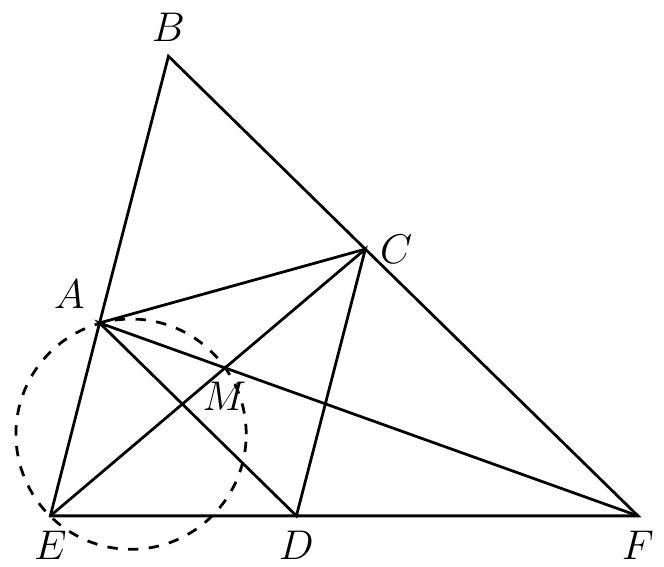
Triangles $A E D$ and $C D F$ are similar, because $A D \| C F$ and $A E \| C D$. Thus, since $A B C$ and $A C D$ are equilateral triangles,
$$
\frac{A E}{C D}=\frac{A D}{C F} \Longleftrighta... | proof | Yes | Yes | proof | Geometry | Let $A B C D$ be a quadrilateral such that all sides have equal length and angle $\angle A B C$ is 60 degrees. Let $\ell$ be a line passing through $D$ and not intersecting the quadrilateral (except at $D)$. Let $E$ and $F$ be the points of intersection of $\ell$ with $A B$ and $B C$ respectively. Let $M$ be the point ... | 
Triangles $A E D$ and $C D F$ are similar, because $A D \| C F$ and $A E \| C D$. Thus, since $A B C$ and $A C D$ are equilateral triangles,
$$
\frac{A E}{C D}=\frac{A D}{C F} \Longleftrighta... | {
"exam": "APMO",
"problem_label": "1",
"problem_match": "# Problem 1",
"resource_path": "APMO/segmented/en-apmo1993_sol.jsonl",
"solution_match": "# Solution\n\n",
"tier": "T1",
"year": "1993"
} |
Find the total number of different integer values the function
$$
f(x)=[x]+[2 x]+\left[\frac{5 x}{3}\right]+[3 x]+[4 x]
$$
takes for real numbers $x$ with $0 \leq x \leq 100$.
Note: $[t]$ is the largest integer that does not exceed $t$.
Answer: 734. | Note that, since $[x+n]=[x]+n$ for any integer $n$,
$$
f(x+3)=[x+3]+[2(x+3)]+\left[\frac{5(x+3)}{3}\right]+[3(x+3)]+[4(x+3)]=f(x)+35,
$$
one only needs to investigate the interval $[0,3)$.
The numbers in this interval at which at least one of the real numbers $x, 2 x, \frac{5 x}{3}, 3 x, 4 x$ is an integer are
- $0,... | 734 | Yes | Yes | math-word-problem | Number Theory | Find the total number of different integer values the function
$$
f(x)=[x]+[2 x]+\left[\frac{5 x}{3}\right]+[3 x]+[4 x]
$$
takes for real numbers $x$ with $0 \leq x \leq 100$.
Note: $[t]$ is the largest integer that does not exceed $t$.
Answer: 734. | Note that, since $[x+n]=[x]+n$ for any integer $n$,
$$
f(x+3)=[x+3]+[2(x+3)]+\left[\frac{5(x+3)}{3}\right]+[3(x+3)]+[4(x+3)]=f(x)+35,
$$
one only needs to investigate the interval $[0,3)$.
The numbers in this interval at which at least one of the real numbers $x, 2 x, \frac{5 x}{3}, 3 x, 4 x$ is an integer are
- $0,... | {
"exam": "APMO",
"problem_label": "2",
"problem_match": "# Problem 2",
"resource_path": "APMO/segmented/en-apmo1993_sol.jsonl",
"solution_match": "# Solution\n\n",
"tier": "T1",
"year": "1993"
} |
Let
$$
f(x)=a_{n} x^{n}+a_{n-1} x^{n-1}+\cdots+a_{0} \quad \text { and } \quad g(x)=c_{n+1} x^{n+1}+c_{n} x^{n}+\cdots+c_{0}
$$
be non-zero polynomials with real coefficients such that $g(x)=(x+r) f(x)$ for some real number $r$. If $a=\max \left(\left|a_{n}\right|, \ldots,\left|a_{0}\right|\right)$ and $c=\max \left(... | Expanding $(x+r) f(x)$, we find that $c_{n+1}=a_{n}, c_{k}=a_{k-1}+r a_{k}$ for $k=1,2, \ldots, n$, and $c_{0}=r a_{0}$. Consider three cases:
- $r=0$. Then $c_{0}=0$ and $c_{k}=a_{k-1}$ for $k=1,2, \ldots, n$, and $a=c \Longrightarrow \frac{a}{c}=1 \leq n+1$.
- $|r| \geq 1$. Then
$$
\begin{gathered}
\left|a_{0}\righ... | proof | Yes | Yes | proof | Algebra | Let
$$
f(x)=a_{n} x^{n}+a_{n-1} x^{n-1}+\cdots+a_{0} \quad \text { and } \quad g(x)=c_{n+1} x^{n+1}+c_{n} x^{n}+\cdots+c_{0}
$$
be non-zero polynomials with real coefficients such that $g(x)=(x+r) f(x)$ for some real number $r$. If $a=\max \left(\left|a_{n}\right|, \ldots,\left|a_{0}\right|\right)$ and $c=\max \left(... | Expanding $(x+r) f(x)$, we find that $c_{n+1}=a_{n}, c_{k}=a_{k-1}+r a_{k}$ for $k=1,2, \ldots, n$, and $c_{0}=r a_{0}$. Consider three cases:
- $r=0$. Then $c_{0}=0$ and $c_{k}=a_{k-1}$ for $k=1,2, \ldots, n$, and $a=c \Longrightarrow \frac{a}{c}=1 \leq n+1$.
- $|r| \geq 1$. Then
$$
\begin{gathered}
\left|a_{0}\righ... | {
"exam": "APMO",
"problem_label": "3",
"problem_match": "# Problem 3",
"resource_path": "APMO/segmented/en-apmo1993_sol.jsonl",
"solution_match": "# Solution\n\n",
"tier": "T1",
"year": "1993"
} |
Determine all positive integers $n$ for which the equation
$$
x^{n}+(2+x)^{n}+(2-x)^{n}=0
$$
has an integer as a solution.
## Answer: $n=1$. | If $n$ is even, $x^{n}+(2+x)^{n}+(2-x)^{n}>0$, so $n$ is odd.
For $n=1$, the equation reduces to $x+(2+x)+(2-x)=0$, which has the unique solution $x=-4$.
For $n>1$, notice that $x$ is even, because $x, 2-x$, and $2+x$ have all the same parity. Let $x=2 y$, so the equation reduces to
$$
y^{n}+(1+y)^{n}+(1-y)^{n}=0 .
$$... | n=1 | Yes | Yes | math-word-problem | Algebra | Determine all positive integers $n$ for which the equation
$$
x^{n}+(2+x)^{n}+(2-x)^{n}=0
$$
has an integer as a solution.
## Answer: $n=1$. | If $n$ is even, $x^{n}+(2+x)^{n}+(2-x)^{n}>0$, so $n$ is odd.
For $n=1$, the equation reduces to $x+(2+x)+(2-x)=0$, which has the unique solution $x=-4$.
For $n>1$, notice that $x$ is even, because $x, 2-x$, and $2+x$ have all the same parity. Let $x=2 y$, so the equation reduces to
$$
y^{n}+(1+y)^{n}+(1-y)^{n}=0 .
$$... | {
"exam": "APMO",
"problem_label": "4",
"problem_match": "# Problem 4",
"resource_path": "APMO/segmented/en-apmo1993_sol.jsonl",
"solution_match": "# Solution\n\n",
"tier": "T1",
"year": "1993"
} |
Let $P_{1}, P_{2}, \ldots, P_{1993}=P_{0}$ be distinct points in the $x y$-plane with the following properties:
(i) both coordinates of $P_{i}$ are integers, for $i=1,2, \ldots, 1993$;
(ii) there is no point other than $P_{i}$ and $P_{i+1}$ on the line segment joining $P_{i}$ with $P_{i+1}$ whose coordinates are both i... | Call a point $(x, y) \in \mathbb{Z}^{2}$ even or odd according to the parity of $x+y$. Since there are an odd number of points, there are two points $P_{i}=(a, b)$ and $P_{i+1}=(c, d), 0 \leq i \leq 1992$ with the same parity. This implies that $a+b+c+d$ is even. We claim that the midpoint of $P_{i} P_{i+1}$ is the des... | proof | Yes | Yes | proof | Number Theory | Let $P_{1}, P_{2}, \ldots, P_{1993}=P_{0}$ be distinct points in the $x y$-plane with the following properties:
(i) both coordinates of $P_{i}$ are integers, for $i=1,2, \ldots, 1993$;
(ii) there is no point other than $P_{i}$ and $P_{i+1}$ on the line segment joining $P_{i}$ with $P_{i+1}$ whose coordinates are both i... | Call a point $(x, y) \in \mathbb{Z}^{2}$ even or odd according to the parity of $x+y$. Since there are an odd number of points, there are two points $P_{i}=(a, b)$ and $P_{i+1}=(c, d), 0 \leq i \leq 1992$ with the same parity. This implies that $a+b+c+d$ is even. We claim that the midpoint of $P_{i} P_{i+1}$ is the des... | {
"exam": "APMO",
"problem_label": "5",
"problem_match": "# Problem 5",
"resource_path": "APMO/segmented/en-apmo1993_sol.jsonl",
"solution_match": "# Solution\n\n",
"tier": "T1",
"year": "1993"
} |
Let $f: \mathbb{R} \rightarrow \mathbb{R}$ be a function such that
(i) For all $x, y \in \mathbb{R}$,
$$
f(x)+f(y)+1 \geq f(x+y) \geq f(x)+f(y)
$$
(ii) For all $x \in[0,1), f(0) \geq f(x)$,
(iii) $-f(-1)=f(1)=1$.
Find all such functions $f$.
Answer: $f(x)=\lfloor x\rfloor$, the largest integer that does not exceed $... | Plug $y \rightarrow 1$ in (i):
$$
f(x)+f(1)+1 \geq f(x+1) \geq f(x)+f(1) \Longleftrightarrow f(x)+1 \leq f(x+1) \leq f(x)+2
$$
Now plug $y \rightarrow-1$ and $x \rightarrow x+1$ in (i):
$$
f(x+1)+f(-1)+1 \geq f(x) \geq f(x+1)+f(-1) \Longleftrightarrow f(x) \leq f(x+1) \leq f(x)+1
$$
Hence $f(x+1)=f(x)+1$ and we onl... | f(x)=\lfloor x\rfloor | Yes | Yes | math-word-problem | Algebra | Let $f: \mathbb{R} \rightarrow \mathbb{R}$ be a function such that
(i) For all $x, y \in \mathbb{R}$,
$$
f(x)+f(y)+1 \geq f(x+y) \geq f(x)+f(y)
$$
(ii) For all $x \in[0,1), f(0) \geq f(x)$,
(iii) $-f(-1)=f(1)=1$.
Find all such functions $f$.
Answer: $f(x)=\lfloor x\rfloor$, the largest integer that does not exceed $... | Plug $y \rightarrow 1$ in (i):
$$
f(x)+f(1)+1 \geq f(x+1) \geq f(x)+f(1) \Longleftrightarrow f(x)+1 \leq f(x+1) \leq f(x)+2
$$
Now plug $y \rightarrow-1$ and $x \rightarrow x+1$ in (i):
$$
f(x+1)+f(-1)+1 \geq f(x) \geq f(x+1)+f(-1) \Longleftrightarrow f(x) \leq f(x+1) \leq f(x)+1
$$
Hence $f(x+1)=f(x)+1$ and we onl... | {
"exam": "APMO",
"problem_label": "1",
"problem_match": "# Problem 1",
"resource_path": "APMO/segmented/en-apmo1994_sol.jsonl",
"solution_match": "# Solution\n\n",
"tier": "T1",
"year": "1994"
} |
Given a nondegenerate triangle $A B C$, with circumcentre $O$, orthocentre $H$, and circumradius $R$, prove that $|O H|<3 R$. | Embed $A B C$ in the complex plane, with $A, B$ and $C$ in the circle $|z|=R$, so $O$ is the origin. Represent each point by its lowercase letter. It is well known that $h=a+b+c$, so
$$
O H=|a+b+c| \leq|a|+|b|+|c|=3 R .
$$
The equality cannot occur because $a, b$, and $c$ are not collinear, so $O H<3 R$. | O H<3 R | Yes | Yes | proof | Geometry | Given a nondegenerate triangle $A B C$, with circumcentre $O$, orthocentre $H$, and circumradius $R$, prove that $|O H|<3 R$. | Embed $A B C$ in the complex plane, with $A, B$ and $C$ in the circle $|z|=R$, so $O$ is the origin. Represent each point by its lowercase letter. It is well known that $h=a+b+c$, so
$$
O H=|a+b+c| \leq|a|+|b|+|c|=3 R .
$$
The equality cannot occur because $a, b$, and $c$ are not collinear, so $O H<3 R$. | {
"exam": "APMO",
"problem_label": "2",
"problem_match": "# Problem 2",
"resource_path": "APMO/segmented/en-apmo1994_sol.jsonl",
"solution_match": "# Solution 1",
"tier": "T1",
"year": "1994"
} |
Given a nondegenerate triangle $A B C$, with circumcentre $O$, orthocentre $H$, and circumradius $R$, prove that $|O H|<3 R$. | Suppose with loss of generality that $\angle A<90^{\circ}$. Let $B D$ be an altitude. Then
$$
A H=\frac{A D}{\cos \left(90^{\circ}-C\right)}=\frac{A B \cos A}{\sin C}=2 R \cos A
$$
By the triangle inequality,
$$
O H<A O+A H=R+2 R \cos A<3 R
$$
Comment: With a bit more work, if $a, b, c$ are the sidelengths of $A B ... | proof | Yes | Yes | proof | Geometry | Given a nondegenerate triangle $A B C$, with circumcentre $O$, orthocentre $H$, and circumradius $R$, prove that $|O H|<3 R$. | Suppose with loss of generality that $\angle A<90^{\circ}$. Let $B D$ be an altitude. Then
$$
A H=\frac{A D}{\cos \left(90^{\circ}-C\right)}=\frac{A B \cos A}{\sin C}=2 R \cos A
$$
By the triangle inequality,
$$
O H<A O+A H=R+2 R \cos A<3 R
$$
Comment: With a bit more work, if $a, b, c$ are the sidelengths of $A B ... | {
"exam": "APMO",
"problem_label": "2",
"problem_match": "# Problem 2",
"resource_path": "APMO/segmented/en-apmo1994_sol.jsonl",
"solution_match": "# Solution 2",
"tier": "T1",
"year": "1994"
} |
Let $n$ be an integer of the form $a^{2}+b^{2}$, where $a$ and $b$ are relatively prime integers and such that if $p$ is a prime, $p \leq \sqrt{n}$, then $p$ divides $a b$. Determine all such $n$.
Answer: $n=2,5,13$. | A prime $p$ divides $a b$ if and only if divides either $a$ or $b$. If $n=a^{2}+b^{2}$ is a composite then it has a prime divisor $p \leq \sqrt{n}$, and if $p$ divides $a$ it divides $b$ and vice-versa, which is not possible because $a$ and $b$ are coprime. Therefore $n$ is a prime.
Suppose without loss of generality t... | n=2,5,13 | Yes | Yes | math-word-problem | Number Theory | Let $n$ be an integer of the form $a^{2}+b^{2}$, where $a$ and $b$ are relatively prime integers and such that if $p$ is a prime, $p \leq \sqrt{n}$, then $p$ divides $a b$. Determine all such $n$.
Answer: $n=2,5,13$. | A prime $p$ divides $a b$ if and only if divides either $a$ or $b$. If $n=a^{2}+b^{2}$ is a composite then it has a prime divisor $p \leq \sqrt{n}$, and if $p$ divides $a$ it divides $b$ and vice-versa, which is not possible because $a$ and $b$ are coprime. Therefore $n$ is a prime.
Suppose without loss of generality t... | {
"exam": "APMO",
"problem_label": "3",
"problem_match": "# Problem 3",
"resource_path": "APMO/segmented/en-apmo1994_sol.jsonl",
"solution_match": "# Solution\n\n",
"tier": "T1",
"year": "1994"
} |
Is there an infinite set of points in the plane such that no three points are collinear, and the distance between any two points is rational?
Answer: Yes. | The answer is yes and we present the following construction: the idea is considering points in the unit circle of the form $P_{n}=(\cos (2 n \theta), \sin (2 n \theta))$ for an appropriate $\theta$. Then the distance $P_{m} P_{n}$ is the length of the chord with central angle $(2 m-2 n) \theta \bmod \pi$, that is, $2|\... | proof | Yes | Yes | proof | Geometry | Is there an infinite set of points in the plane such that no three points are collinear, and the distance between any two points is rational?
Answer: Yes. | The answer is yes and we present the following construction: the idea is considering points in the unit circle of the form $P_{n}=(\cos (2 n \theta), \sin (2 n \theta))$ for an appropriate $\theta$. Then the distance $P_{m} P_{n}$ is the length of the chord with central angle $(2 m-2 n) \theta \bmod \pi$, that is, $2|\... | {
"exam": "APMO",
"problem_label": "4",
"problem_match": "# Problem 4",
"resource_path": "APMO/segmented/en-apmo1994_sol.jsonl",
"solution_match": "# Solution 1",
"tier": "T1",
"year": "1994"
} |
Is there an infinite set of points in the plane such that no three points are collinear, and the distance between any two points is rational?
Answer: Yes. | We present a different construction. Consider the (collinear) points
$$
P_{k}=\left(1, \frac{x_{k}}{y_{k}}\right),
$$
such that the distance $O P_{k}$ from the origin $O$,
$$
O P_{k}=\frac{\sqrt{x_{k}^{2}+y_{k}^{2}}}{y_{k}}
$$
is rational, and $x_{k}$ and $y_{k}$ are integers. Clearly, $P_{i} P_{j}=\left|\frac{x_{i... | proof | Yes | Yes | proof | Geometry | Is there an infinite set of points in the plane such that no three points are collinear, and the distance between any two points is rational?
Answer: Yes. | We present a different construction. Consider the (collinear) points
$$
P_{k}=\left(1, \frac{x_{k}}{y_{k}}\right),
$$
such that the distance $O P_{k}$ from the origin $O$,
$$
O P_{k}=\frac{\sqrt{x_{k}^{2}+y_{k}^{2}}}{y_{k}}
$$
is rational, and $x_{k}$ and $y_{k}$ are integers. Clearly, $P_{i} P_{j}=\left|\frac{x_{i... | {
"exam": "APMO",
"problem_label": "4",
"problem_match": "# Problem 4",
"resource_path": "APMO/segmented/en-apmo1994_sol.jsonl",
"solution_match": "# Solution 2",
"tier": "T1",
"year": "1994"
} |
You are given three lists $A, B$, and $C$. List $A$ contains the numbers of the form $10^{k}$ in base 10, with $k$ any integer greater than or equal to 1 . Lists $B$ and $C$ contain the same numbers translated into base 2 and 5 respectively:
| $A$ | $B$ | $C$ |
| :--- | :--- | :--- |
| 10 | 1010 | 20 |
| 100 | 1100100... | Let $b_{k}$ and $c_{k}$ be the number of digits in the $k$ th term in lists $B$ and $C$, respectively. Then
$$
2^{b_{k}-1} \leq 10^{k}<2^{b_{k}} \Longleftrightarrow \log _{2} 10^{k}<b_{k} \leq \log _{2} 10^{k}+1 \Longleftrightarrow b_{k}=\left\lfloor k \cdot \log _{2} 10\right\rfloor+1
$$
and, similarly
$$
c_{k}=\le... | proof | Yes | Yes | proof | Number Theory | You are given three lists $A, B$, and $C$. List $A$ contains the numbers of the form $10^{k}$ in base 10, with $k$ any integer greater than or equal to 1 . Lists $B$ and $C$ contain the same numbers translated into base 2 and 5 respectively:
| $A$ | $B$ | $C$ |
| :--- | :--- | :--- |
| 10 | 1010 | 20 |
| 100 | 1100100... | Let $b_{k}$ and $c_{k}$ be the number of digits in the $k$ th term in lists $B$ and $C$, respectively. Then
$$
2^{b_{k}-1} \leq 10^{k}<2^{b_{k}} \Longleftrightarrow \log _{2} 10^{k}<b_{k} \leq \log _{2} 10^{k}+1 \Longleftrightarrow b_{k}=\left\lfloor k \cdot \log _{2} 10\right\rfloor+1
$$
and, similarly
$$
c_{k}=\le... | {
"exam": "APMO",
"problem_label": "5",
"problem_match": "# Problem 5",
"resource_path": "APMO/segmented/en-apmo1994_sol.jsonl",
"solution_match": "# Solution\n\n",
"tier": "T1",
"year": "1994"
} |
Find the smallest positive integer $n$ with the following property : There does not exist an arithmetic progression of 1993 terms of real numbers containing exactly $n$ integers. | and Marking Scheme:
We first note that the integer terms of any arithmetic progression are "equally spaced", because if the $i$ th term $a_{i}$ and the $(i+j)$ th term $a_{i+j}$ of an arithmetic progression are both integers, then so is the $(i+2 j)$ th term $a_{i+2 j}=a_{i+j}+\left(a_{i+j}-a_{i}\right)$.
1 POINT for ... | 70 | Yes | Yes | math-word-problem | Number Theory | Find the smallest positive integer $n$ with the following property : There does not exist an arithmetic progression of 1993 terms of real numbers containing exactly $n$ integers. | and Marking Scheme:
We first note that the integer terms of any arithmetic progression are "equally spaced", because if the $i$ th term $a_{i}$ and the $(i+j)$ th term $a_{i+j}$ of an arithmetic progression are both integers, then so is the $(i+2 j)$ th term $a_{i+2 j}=a_{i+j}+\left(a_{i+j}-a_{i}\right)$.
1 POINT for ... | {
"exam": "APMO",
"problem_label": "1",
"problem_match": "\nProblem 1.",
"resource_path": "APMO/segmented/en-apmo1999_sol.jsonl",
"solution_match": "\nSolution ",
"tier": "T1",
"year": "1999"
} |
Let $a_{1}, a_{2}, \cdots$ be a sequence of real numbers satisfying $a_{i+j} \leq a_{i}+a_{j}$ for all $i, j=1,2, \cdots$. Prove that
$$
a_{1}+\frac{a_{2}}{2}+\frac{a_{3}}{3}+\cdots+\frac{a_{n}}{n} \geq a_{n}
$$
for each positive integer $n$. | and Marking Scheme:
Letting $b_{i}=a_{i} / i,(i=1,2, \cdots)$, we prove that
$$
b_{1}+\cdots+b_{n} \geq a_{n} \quad(n=1,2, \cdots)
$$
by induction on $n$. For $n=1, b_{1}=a_{1} \geq a_{1}$, and the induction starts. Assume that
$$
b_{1}+\cdots+b_{k} \geq a_{k}
$$
for all $k=1,2, \cdots, n-1$. It suffices to prove ... | proof | Yes | Yes | proof | Inequalities | Let $a_{1}, a_{2}, \cdots$ be a sequence of real numbers satisfying $a_{i+j} \leq a_{i}+a_{j}$ for all $i, j=1,2, \cdots$. Prove that
$$
a_{1}+\frac{a_{2}}{2}+\frac{a_{3}}{3}+\cdots+\frac{a_{n}}{n} \geq a_{n}
$$
for each positive integer $n$. | and Marking Scheme:
Letting $b_{i}=a_{i} / i,(i=1,2, \cdots)$, we prove that
$$
b_{1}+\cdots+b_{n} \geq a_{n} \quad(n=1,2, \cdots)
$$
by induction on $n$. For $n=1, b_{1}=a_{1} \geq a_{1}$, and the induction starts. Assume that
$$
b_{1}+\cdots+b_{k} \geq a_{k}
$$
for all $k=1,2, \cdots, n-1$. It suffices to prove ... | {
"exam": "APMO",
"problem_label": "2",
"problem_match": "\nProblem 2.",
"resource_path": "APMO/segmented/en-apmo1999_sol.jsonl",
"solution_match": "# Solution ",
"tier": "T1",
"year": "1999"
} |
Let $\Gamma_{1}$ and $\Gamma_{2}$ be two circles intersecting at $P$ and $Q$. The common tangent, closer to $P$, of $\Gamma_{1}$ and $\Gamma_{2}$ touches $\Gamma_{1}$ at $A$ and $\Gamma_{2}$ at $B$. The tangent of $\Gamma_{1}$ at $P$ meets $\Gamma_{2}$ at $C$, which is different from $P$ and the extension of $A P$ meet... | and Marking Scheme:
Let $\alpha=\angle P A B, \beta=\angle A B P$ y $\gamma=\angle Q A P$. Then, since $P C$ is tangent to $\Gamma_{1}$, we have $\angle Q P C=$ $\angle Q B C=\gamma$. Thus $A, B, R, Q$ are concyclic.
3 POINTS for proving that $A, B, R, Q$ are concyclic.
Since $A B$ is a common tangent to $\Gamma_{1}$... | proof | Yes | Yes | proof | Geometry | Let $\Gamma_{1}$ and $\Gamma_{2}$ be two circles intersecting at $P$ and $Q$. The common tangent, closer to $P$, of $\Gamma_{1}$ and $\Gamma_{2}$ touches $\Gamma_{1}$ at $A$ and $\Gamma_{2}$ at $B$. The tangent of $\Gamma_{1}$ at $P$ meets $\Gamma_{2}$ at $C$, which is different from $P$ and the extension of $A P$ meet... | and Marking Scheme:
Let $\alpha=\angle P A B, \beta=\angle A B P$ y $\gamma=\angle Q A P$. Then, since $P C$ is tangent to $\Gamma_{1}$, we have $\angle Q P C=$ $\angle Q B C=\gamma$. Thus $A, B, R, Q$ are concyclic.
3 POINTS for proving that $A, B, R, Q$ are concyclic.
Since $A B$ is a common tangent to $\Gamma_{1}$... | {
"exam": "APMO",
"problem_label": "3",
"problem_match": "\nProblem 3.",
"resource_path": "APMO/segmented/en-apmo1999_sol.jsonl",
"solution_match": "# Solution ",
"tier": "T1",
"year": "1999"
} |
Determine all pairs $(a, b)$ of integers with the property that the numbers $a^{2}+4 b$ and $b^{2}+4 a$ are both perfect squares. | and Marking Scheme:
Without loss of gencrality, assume that $|b| \leq|a|$. If $b=0$, then $a$ must be a perfect square. So ( $a=k^{2}, b=0$ ) for each $k \in Z$ is a solution.
Now we consider the case $b \neq 0$. Because $a^{2}+4 b$ is a perfect square, the quadratic equation
$$
x^{2}+a x-b=0
$$
has two non-zero int... | (-4,-4),(-5,-6),(-6,-5),\left(0, k^{2}\right),\left(k^{2}, 0\right),(k, 1-k) | Yes | Yes | math-word-problem | Number Theory | Determine all pairs $(a, b)$ of integers with the property that the numbers $a^{2}+4 b$ and $b^{2}+4 a$ are both perfect squares. | and Marking Scheme:
Without loss of gencrality, assume that $|b| \leq|a|$. If $b=0$, then $a$ must be a perfect square. So ( $a=k^{2}, b=0$ ) for each $k \in Z$ is a solution.
Now we consider the case $b \neq 0$. Because $a^{2}+4 b$ is a perfect square, the quadratic equation
$$
x^{2}+a x-b=0
$$
has two non-zero int... | {
"exam": "APMO",
"problem_label": "4",
"problem_match": "\nProblem 4.",
"resource_path": "APMO/segmented/en-apmo1999_sol.jsonl",
"solution_match": "# First Solution ",
"tier": "T1",
"year": "1999"
} |
Determine all pairs $(a, b)$ of integers with the property that the numbers $a^{2}+4 b$ and $b^{2}+4 a$ are both perfect squares. | and Marking Scheme:
Without loss of generality assume that $|b| \leq|a|$. Then $a^{2}+4 b \leq a^{2}+4|a|<a^{2}+4|a|+4=(|a|+2)^{2}$. Given that $a^{2}+4 b$ is a perfect square and since $a^{2}+4 b$ y $a^{2}$ have same parity then $a^{2}+4 b \neq(|a|+1)^{2}$, so
$$
a^{2}+4 b \leq a^{2}
$$
2 POINTS for proving (1).
Le... | (k^{2}, 0), (0, k^{2}), (k, 1-k), (-6, -5), (-5, -6), (-4, -4) | Yes | Yes | math-word-problem | Number Theory | Determine all pairs $(a, b)$ of integers with the property that the numbers $a^{2}+4 b$ and $b^{2}+4 a$ are both perfect squares. | and Marking Scheme:
Without loss of generality assume that $|b| \leq|a|$. Then $a^{2}+4 b \leq a^{2}+4|a|<a^{2}+4|a|+4=(|a|+2)^{2}$. Given that $a^{2}+4 b$ is a perfect square and since $a^{2}+4 b$ y $a^{2}$ have same parity then $a^{2}+4 b \neq(|a|+1)^{2}$, so
$$
a^{2}+4 b \leq a^{2}
$$
2 POINTS for proving (1).
Le... | {
"exam": "APMO",
"problem_label": "4",
"problem_match": "\nProblem 4.",
"resource_path": "APMO/segmented/en-apmo1999_sol.jsonl",
"solution_match": "# Second Solution ",
"tier": "T1",
"year": "1999"
} |
End of preview. Expand in Data Studio
README.md exists but content is empty.
- Downloads last month
- 49