
Get trending papers in your email inbox once a day!
Get trending papers in your email inbox!
Subscribe
Generating particle physics Lagrangians with transformers
In physics, Lagrangians provide a systematic way to describe laws governing physical systems. In the context of particle physics, they encode the interactions and behavior of the fundamental building blocks of our universe. By treating Lagrangians as complex, rule-based constructs similar to linguistic expressions, we trained a transformer model -- proven to be effective in natural language tasks -- to predict the Lagrangian corresponding to a given list of particles. We report on the transformer's performance in constructing Lagrangians respecting the Standard Model SU(3)times SU(2)times U(1) gauge symmetries. The resulting model is shown to achieve high accuracies (over 90\%) with Lagrangians up to six matter fields, with the capacity to generalize beyond the training distribution, albeit within architectural constraints. We show through an analysis of input embeddings that the model has internalized concepts such as group representations and conjugation operations as it learned to generate Lagrangians. We make the model and training datasets available to the community. An interactive demonstration can be found at: https://huggingface.co/spaces/JoseEliel/generate-lagrangians.
Lagrangian Flow Networks for Conservation Laws
We introduce Lagrangian Flow Networks (LFlows) for modeling fluid densities and velocities continuously in space and time. By construction, the proposed LFlows satisfy the continuity equation, a PDE describing mass conservation in its differentiable form. Our model is based on the insight that solutions to the continuity equation can be expressed as time-dependent density transformations via differentiable and invertible maps. This follows from classical theory of the existence and uniqueness of Lagrangian flows for smooth vector fields. Hence, we model fluid densities by transforming a base density with parameterized diffeomorphisms conditioned on time. The key benefit compared to methods relying on numerical ODE solvers or PINNs is that the analytic expression of the velocity is always consistent with changes in density. Furthermore, we require neither expensive numerical solvers, nor additional penalties to enforce the PDE. LFlows show higher predictive accuracy in density modeling tasks compared to competing models in 2D and 3D, while being computationally efficient. As a real-world application, we model bird migration based on sparse weather radar measurements.
Variational integrals on Hessian spaces: partial regularity for critical points
We develop regularity theory for critical points of variational integrals defined on Hessian spaces of functions on open, bounded subdomains of R^n, under compactly supported variations. The critical point solves a fourth order nonlinear equation in double divergence form. We show that for smooth convex functionals, a W^{2,infty} critical point with bounded Hessian is smooth provided that its Hessian has a small bounded mean oscillation (BMO). We deduce that the interior singular set of a critical point has Hausdorff dimension at most n-p_0, for some p_0 in (2,3). We state some applications of our results to variational problems in Lagrangian geometry. Finally, we use the Hamiltonian stationary equation to demonstrate the importance of our assumption on the a priori regularity of the critical point.
Dual Lagrangian Learning for Conic Optimization
This paper presents Dual Lagrangian Learning (DLL), a principled learning methodology for dual conic optimization proxies. DLL leverages conic duality and the representation power of ML models to provide high-duality, dual-feasible solutions, and therefore valid Lagrangian dual bounds, for linear and nonlinear conic optimization problems. The paper introduces a systematic dual completion procedure, differentiable conic projection layers, and a self-supervised learning framework based on Lagrangian duality. It also provides closed-form dual completion formulae for broad classes of conic problems, which eliminate the need for costly implicit layers. The effectiveness of DLL is demonstrated on linear and nonlinear conic optimization problems. The proposed methodology significantly outperforms a state-of-the-art learning-based method, and achieves 1000x speedups over commercial interior-point solvers with optimality gaps under 0.5\% on average.
Differentiable Solver Search for Fast Diffusion Sampling
Diffusion models have demonstrated remarkable generation quality but at the cost of numerous function evaluations. Recently, advanced ODE-based solvers have been developed to mitigate the substantial computational demands of reverse-diffusion solving under limited sampling steps. However, these solvers, heavily inspired by Adams-like multistep methods, rely solely on t-related Lagrange interpolation. We show that t-related Lagrange interpolation is suboptimal for diffusion model and reveal a compact search space comprised of time steps and solver coefficients. Building on our analysis, we propose a novel differentiable solver search algorithm to identify more optimal solver. Equipped with the searched solver, rectified-flow models, e.g., SiT-XL/2 and FlowDCN-XL/2, achieve FID scores of 2.40 and 2.35, respectively, on ImageNet256 with only 10 steps. Meanwhile, DDPM model, DiT-XL/2, reaches a FID score of 2.33 with only 10 steps. Notably, our searched solver outperforms traditional solvers by a significant margin. Moreover, our searched solver demonstrates generality across various model architectures, resolutions, and model sizes.


Cutting Slack: Quantum Optimization with Slack-Free Methods for Combinatorial Benchmarks
Constraint handling remains a key bottleneck in quantum combinatorial optimization. While slack-variable-based encodings are straightforward, they significantly increase qubit counts and circuit depth, challenging the scalability of quantum solvers. In this work, we investigate a suite of Lagrangian-based optimization techniques including dual ascent, bundle methods, cutting plane approaches, and augmented Lagrangian formulations for solving constrained combinatorial problems on quantum simulators and hardware. Our framework is applied to three representative NP-hard problems: the Travelling Salesman Problem (TSP), the Multi-Dimensional Knapsack Problem (MDKP), and the Maximum Independent Set (MIS). We demonstrate that MDKP and TSP, with their inequality-based or degree-constrained structures, allow for slack-free reformulations, leading to significant qubit savings without compromising performance. In contrast, MIS does not inherently benefit from slack elimination but still gains in feasibility and objective quality from principled Lagrangian updates. We benchmark these methods across classically hard instances, analyzing trade-offs in qubit usage, feasibility, and optimality gaps. Our results highlight the flexibility of Lagrangian formulations as a scalable alternative to naive QUBO penalization, even when qubit savings are not always achievable. This work provides practical insights for deploying constraint-aware quantum optimization pipelines, with applications in logistics, network design, and resource allocation.

Near-Optimal Solutions of Constrained Learning Problems
With the widespread adoption of machine learning systems, the need to curtail their behavior has become increasingly apparent. This is evidenced by recent advancements towards developing models that satisfy robustness, safety, and fairness requirements. These requirements can be imposed (with generalization guarantees) by formulating constrained learning problems that can then be tackled by dual ascent algorithms. Yet, though these algorithms converge in objective value, even in non-convex settings, they cannot guarantee that their outcome is feasible. Doing so requires randomizing over all iterates, which is impractical in virtually any modern applications. Still, final iterates have been observed to perform well in practice. In this work, we address this gap between theory and practice by characterizing the constraint violation of Lagrangian minimizers associated with optimal dual variables, despite lack of convexity. To do this, we leverage the fact that non-convex, finite-dimensional constrained learning problems can be seen as parametrizations of convex, functional problems. Our results show that rich parametrizations effectively mitigate the issue of feasibility in dual methods, shedding light on prior empirical successes of dual learning. We illustrate our findings in fair learning tasks.
Averaged Method of Multipliers for Bi-Level Optimization without Lower-Level Strong Convexity
Gradient methods have become mainstream techniques for Bi-Level Optimization (BLO) in learning fields. The validity of existing works heavily rely on either a restrictive Lower- Level Strong Convexity (LLSC) condition or on solving a series of approximation subproblems with high accuracy or both. In this work, by averaging the upper and lower level objectives, we propose a single loop Bi-level Averaged Method of Multipliers (sl-BAMM) for BLO that is simple yet efficient for large-scale BLO and gets rid of the limited LLSC restriction. We further provide non-asymptotic convergence analysis of sl-BAMM towards KKT stationary points, and the comparative advantage of our analysis lies in the absence of strong gradient boundedness assumption, which is always required by others. Thus our theory safely captures a wider variety of applications in deep learning, especially where the upper-level objective is quadratic w.r.t. the lower-level variable. Experimental results demonstrate the superiority of our method.

Learnable Multipliers: Freeing the Scale of Language Model Matrix Layers
Applying weight decay (WD) to matrix layers is standard practice in large-language-model pretraining. Prior work suggests that stochastic gradient noise induces a Brownian-like expansion of the weight matrices W, whose growth is counteracted by WD, leading to a WD-noise equilibrium with a certain weight norm ||W||. In this work, we view the equilibrium norm as a harmful artifact of the training procedure, and address it by introducing learnable multipliers to learn the optimal scale. First, we attach a learnable scalar multiplier to W and confirm that the WD-noise equilibrium norm is suboptimal: the learned scale adapts to data and improves performance. We then argue that individual row and column norms are similarly constrained, and free their scale by introducing learnable per-row and per-column multipliers. Our method can be viewed as a learnable, more expressive generalization of muP multipliers. It outperforms a well-tuned muP baseline, reduces the computational overhead of multiplier tuning, and surfaces practical questions such as forward-pass symmetries and the width-scaling of the learned multipliers. Finally, we validate learnable multipliers with both Adam and Muon optimizers, where it shows improvement in downstream evaluations matching the improvement of the switching from Adam to Muon.

Neural Network Approximations of PDEs Beyond Linearity: A Representational Perspective
A burgeoning line of research leverages deep neural networks to approximate the solutions to high dimensional PDEs, opening lines of theoretical inquiry focused on explaining how it is that these models appear to evade the curse of dimensionality. However, most prior theoretical analyses have been limited to linear PDEs. In this work, we take a step towards studying the representational power of neural networks for approximating solutions to nonlinear PDEs. We focus on a class of PDEs known as nonlinear elliptic variational PDEs, whose solutions minimize an Euler-Lagrange energy functional E(u) = int_Omega L(x, u(x), nabla u(x)) - f(x) u(x)dx. We show that if composing a function with Barron norm b with partial derivatives of L produces a function of Barron norm at most B_L b^p, the solution to the PDE can be epsilon-approximated in the L^2 sense by a function with Barron norm Oleft(left(dB_Lright)^{max{p log(1/ epsilon), p^{log(1/epsilon)}}}right). By a classical result due to Barron [1993], this correspondingly bounds the size of a 2-layer neural network needed to approximate the solution. Treating p, epsilon, B_L as constants, this quantity is polynomial in dimension, thus showing neural networks can evade the curse of dimensionality. Our proof technique involves neurally simulating (preconditioned) gradient in an appropriate Hilbert space, which converges exponentially fast to the solution of the PDE, and such that we can bound the increase of the Barron norm at each iterate. Our results subsume and substantially generalize analogous prior results for linear elliptic PDEs over a unit hypercube.
MovingParts: Motion-based 3D Part Discovery in Dynamic Radiance Field
We present MovingParts, a NeRF-based method for dynamic scene reconstruction and part discovery. We consider motion as an important cue for identifying parts, that all particles on the same part share the common motion pattern. From the perspective of fluid simulation, existing deformation-based methods for dynamic NeRF can be seen as parameterizing the scene motion under the Eulerian view, i.e., focusing on specific locations in space through which the fluid flows as time passes. However, it is intractable to extract the motion of constituting objects or parts using the Eulerian view representation. In this work, we introduce the dual Lagrangian view and enforce representations under the Eulerian/Lagrangian views to be cycle-consistent. Under the Lagrangian view, we parameterize the scene motion by tracking the trajectory of particles on objects. The Lagrangian view makes it convenient to discover parts by factorizing the scene motion as a composition of part-level rigid motions. Experimentally, our method can achieve fast and high-quality dynamic scene reconstruction from even a single moving camera, and the induced part-based representation allows direct applications of part tracking, animation, 3D scene editing, etc.

Two-timescale Extragradient for Finding Local Minimax Points
Minimax problems are notoriously challenging to optimize. However, we demonstrate that the two-timescale extragradient can be a viable solution. By utilizing dynamical systems theory, we show that it converges to points that satisfy the second-order necessary condition of local minimax points, under a mild condition. This work surpasses all previous results as we eliminate a crucial assumption that the Hessian, with respect to the maximization variable, is nondegenerate.
The Minkowski Billiard Characterization of the EHZ-capacity of Convex Lagrangian Products
We rigorously state the connection between the EHZ-capacity of convex Lagrangian products Ktimes TsubsetR^ntimesR^n and the minimal length of closed (K,T)-Minkowski billiard trajectories. This connection was made explicit for the first time by Artstein-Avidan and Ostrover under the assumption of smoothness and strict convexity of both K and T. We prove this connection in its full generality, i.e., without requiring any conditions on the convex bodies K and T. This prepares the computation of the EHZ-capacity of convex Lagrangian products of two convex polytopes by using discrete computational methods.
EuLagNet: Eulerian Fluid Prediction with Lagrangian Dynamics
Accurately predicting the future fluid is important to extensive areas, such as meteorology, oceanology and aerodynamics. However, since the fluid is usually observed from an Eulerian perspective, its active and intricate dynamics are seriously obscured and confounded in static grids, bringing horny challenges to the prediction. This paper introduces a new Lagrangian-guided paradigm to tackle the tanglesome fluid dynamics. Instead of solely predicting the future based on Eulerian observations, we propose the Eulerian-Lagrangian Dual Recurrent Network (EuLagNet), which captures multiscale fluid dynamics by tracking movements of adaptively sampled key particles on multiple scales and integrating dynamics information over time. Concretely, a EuLag Block is presented to communicate the learned Eulerian and Lagrangian features at each moment and scale, where the motion of tracked particles is inferred from Eulerian observations and their accumulated dynamics information is incorporated into Eulerian fields to guide future prediction. Tracking key particles not only provides a clear and interpretable clue for fluid dynamics but also makes our model free from modeling complex correlations among massive grids for better efficiency. Experimentally, EuLagNet excels in three challenging fluid prediction tasks, covering both 2D and 3D, simulated and real-world fluids.
Concise Reasoning in the Lens of Lagrangian Optimization
Concise reasoning in large language models seeks to generate only essential intermediate steps needed to arrive at a final answer, thereby alleviating issues of overthinking. Most proposed approaches hinge on carefully hand-crafted heuristics, struggling to balance concision with performance, often failing to adapt across domains and model scales. In this work, we address these challenges by introducing a principled and pragmatic strategy, performance-aware length updating (PALU). As a principled algorithm, PALU formulates concise reasoning as a constrained optimization problem, minimizing response length subject to a performance constraint, and then applies Lagrangian optimization to convert it into a tractable unconstrained problem. As a pragmatic solution, PALU streamlines complicated update rules through three approximations: (i) estimating performance with off-policy rollouts, (ii) truncating the Lagrange multiplier to two extremes, and (iii) replacing gradient-based updates with quantile-driven length adjustments. PALU reduces output length by 65% while improving accuracy by 15% when applied to DeepSeek-Distill-Qwen-1.5B, averaged over five benchmarks, outperforming a range of alternative methods. Furthermore, PALU is demonstrated to adapt across both domain (logic, STEM and math) and model scale (1.5B, 7B, 14B) entrenching the algorithm as a practical and effective concise reasoning approach.
Constrained Optimization via Exact Augmented Lagrangian and Randomized Iterative Sketching
We consider solving equality-constrained nonlinear, nonconvex optimization problems. This class of problems appears widely in a variety of applications in machine learning and engineering, ranging from constrained deep neural networks, to optimal control, to PDE-constrained optimization. We develop an adaptive inexact Newton method for this problem class. In each iteration, we solve the Lagrangian Newton system inexactly via a randomized iterative sketching solver, and select a suitable stepsize by performing line search on an exact augmented Lagrangian merit function. The randomized solvers have advantages over deterministic linear system solvers by significantly reducing per-iteration flops complexity and storage cost, when equipped with suitable sketching matrices. Our method adaptively controls the accuracy of the randomized solver and the penalty parameters of the exact augmented Lagrangian, to ensure that the inexact Newton direction is a descent direction of the exact augmented Lagrangian. This allows us to establish a global almost sure convergence. We also show that a unit stepsize is admissible locally, so that our method exhibits a local linear convergence. Furthermore, we prove that the linear convergence can be strengthened to superlinear convergence if we gradually sharpen the adaptive accuracy condition on the randomized solver. We demonstrate the superior performance of our method on benchmark nonlinear problems in CUTEst test set, constrained logistic regression with data from LIBSVM, and a PDE-constrained problem.

MomentaMorph: Unsupervised Spatial-Temporal Registration with Momenta, Shooting, and Correction
Tagged magnetic resonance imaging (tMRI) has been employed for decades to measure the motion of tissue undergoing deformation. However, registration-based motion estimation from tMRI is difficult due to the periodic patterns in these images, particularly when the motion is large. With a larger motion the registration approach gets trapped in a local optima, leading to motion estimation errors. We introduce a novel "momenta, shooting, and correction" framework for Lagrangian motion estimation in the presence of repetitive patterns and large motion. This framework, grounded in Lie algebra and Lie group principles, accumulates momenta in the tangent vector space and employs exponential mapping in the diffeomorphic space for rapid approximation towards true optima, circumventing local optima. A subsequent correction step ensures convergence to true optima. The results on a 2D synthetic dataset and a real 3D tMRI dataset demonstrate our method's efficiency in estimating accurate, dense, and diffeomorphic 2D/3D motion fields amidst large motion and repetitive patterns.
DGNO: A Novel Physics-aware Neural Operator for Solving Forward and Inverse PDE Problems based on Deep, Generative Probabilistic Modeling
Solving parametric partial differential equations (PDEs) and associated PDE-based, inverse problems is a central task in engineering and physics, yet existing neural operator methods struggle with high-dimensional, discontinuous inputs and require large amounts of {\em labeled} training data. We propose the Deep Generative Neural Operator (DGNO), a physics-aware framework that addresses these challenges by leveraging a deep, generative, probabilistic model in combination with a set of lower-dimensional, latent variables that simultaneously encode PDE-inputs and PDE-outputs. This formulation can make use of unlabeled data and significantly improves inverse problem-solving, particularly for discontinuous or discrete-valued input functions. DGNO enforces physics constraints without labeled data by incorporating as virtual observables, weak-form residuals based on compactly supported radial basis functions (CSRBFs). These relax regularity constraints and eliminate higher-order derivatives from the objective function. We also introduce MultiONet, a novel neural operator architecture, which is a more expressive generalization of the popular DeepONet that significantly enhances the approximating power of the proposed model. These innovations make DGNO particularly effective for challenging forward and inverse, PDE-based problems, such as those involving multi-phase media. Numerical experiments demonstrate that DGNO achieves higher accuracy across multiple benchmarks while exhibiting robustness to noise and strong generalization to out-of-distribution cases. Its adaptability, and the ability to handle sparse, noisy data while providing probabilistic estimates, make DGNO a powerful tool for scientific and engineering applications.
Homoclinic Floer homology via direct limits
Let (M omega) be a two dimensional symplectic manifold, phi: M to M a symplectomorphism with hyperbolic fixed point x and transversely intersecting stable and unstable manifolds W^s(phi, x) cap W^u(phi, x)=:H(phi, x). The intersection points are called homoclinic points, and the stable and unstable manifold are in this situation Lagrangian submanifolds. For this Lagrangian intersection problem with its infinite number of intersection points and wild oscillation behavior, we first define a Floer homology generated by finite sets of so-called contractible homoclinic points. This generalizes very significantly the Floer homologies generated by (semi)primary points defined by us in earlier works. Nevertheless these Floer homologies only consider quite `local' aspects of W^s(phi, x) cap W^u(phi, x) since their generator sets are finite, but the number of all contractible homoclinic points is infinite. To overcome this issue, we construct a direct limit of these `local' homoclinic Floer homologies over suitable index sets. These direct limits thus accumulate the information gathered by the finitely generated local' homoclinic Floer homologies.
Reduced-Order Neural Operators: Learning Lagrangian Dynamics on Highly Sparse Graphs
We present a neural operator architecture to simulate Lagrangian dynamics, such as fluid flow, granular flows, and elastoplasticity. Traditional numerical methods, such as the finite element method (FEM), suffer from long run times and large memory consumption. On the other hand, approaches based on graph neural networks are faster but still suffer from long computation times on dense graphs, which are often required for high-fidelity simulations. Our model, GIOROM or Graph Interaction Operator for Reduced-Order Modeling, learns temporal dynamics within a reduced-order setting, capturing spatial features from a highly sparse graph representation of the input and generalizing to arbitrary spatial locations during inference. The model is geometry-aware and discretization-agnostic and can generalize to different initial conditions, velocities, and geometries after training. We show that point clouds of the order of 100,000 points can be inferred from sparse graphs with sim1000 points, with negligible change in computation time. We empirically evaluate our model on elastic solids, Newtonian fluids, Non-Newtonian fluids, Drucker-Prager granular flows, and von Mises elastoplasticity. On these benchmarks, our approach results in a 25times speedup compared to other neural network-based physics simulators while delivering high-fidelity predictions of complex physical systems and showing better performance on most benchmarks. The code and the demos are provided at https://github.com/HrishikeshVish/GIOROM.


Second-order optimization with lazy Hessians
We analyze Newton's method with lazy Hessian updates for solving general possibly non-convex optimization problems. We propose to reuse a previously seen Hessian for several iterations while computing new gradients at each step of the method. This significantly reduces the overall arithmetical complexity of second-order optimization schemes. By using the cubic regularization technique, we establish fast global convergence of our method to a second-order stationary point, while the Hessian does not need to be updated each iteration. For convex problems, we justify global and local superlinear rates for lazy Newton steps with quadratic regularization, which is easier to compute. The optimal frequency for updating the Hessian is once every d iterations, where d is the dimension of the problem. This provably improves the total arithmetical complexity of second-order algorithms by a factor d.


Addition is All You Need for Energy-efficient Language Models
Large neural networks spend most computation on floating point tensor multiplications. In this work, we find that a floating point multiplier can be approximated by one integer adder with high precision. We propose the linear-complexity multiplication L-Mul algorithm that approximates floating point number multiplication with integer addition operations. The new algorithm costs significantly less computation resource than 8-bit floating point multiplication but achieves higher precision. Compared to 8-bit floating point multiplications, the proposed method achieves higher precision but consumes significantly less bit-level computation. Since multiplying floating point numbers requires substantially higher energy compared to integer addition operations, applying the L-Mul operation in tensor processing hardware can potentially reduce 95% energy cost by element-wise floating point tensor multiplications and 80% energy cost of dot products. We calculated the theoretical error expectation of L-Mul, and evaluated the algorithm on a wide range of textual, visual, and symbolic tasks, including natural language understanding, structural reasoning, mathematics, and commonsense question answering. Our numerical analysis experiments agree with the theoretical error estimation, which indicates that L-Mul with 4-bit mantissa achieves comparable precision as float8_e4m3 multiplications, and L-Mul with 3-bit mantissa outperforms float8_e5m2. Evaluation results on popular benchmarks show that directly applying L-Mul to the attention mechanism is almost lossless. We further show that replacing all floating point multiplications with 3-bit mantissa L-Mul in a transformer model achieves equivalent precision as using float8_e4m3 as accumulation precision in both fine-tuning and inference.

Constrained Bi-Level Optimization: Proximal Lagrangian Value function Approach and Hessian-free Algorithm
This paper presents a new approach and algorithm for solving a class of constrained Bi-Level Optimization (BLO) problems in which the lower-level problem involves constraints coupling both upper-level and lower-level variables. Such problems have recently gained significant attention due to their broad applicability in machine learning. However, conventional gradient-based methods unavoidably rely on computationally intensive calculations related to the Hessian matrix. To address this challenge, we begin by devising a smooth proximal Lagrangian value function to handle the constrained lower-level problem. Utilizing this construct, we introduce a single-level reformulation for constrained BLOs that transforms the original BLO problem into an equivalent optimization problem with smooth constraints. Enabled by this reformulation, we develop a Hessian-free gradient-based algorithm-termed proximal Lagrangian Value function-based Hessian-free Bi-level Algorithm (LV-HBA)-that is straightforward to implement in a single loop manner. Consequently, LV-HBA is especially well-suited for machine learning applications. Furthermore, we offer non-asymptotic convergence analysis for LV-HBA, eliminating the need for traditional strong convexity assumptions for the lower-level problem while also being capable of accommodating non-singleton scenarios. Empirical results substantiate the algorithm's superior practical performance.
Multimarginal generative modeling with stochastic interpolants
Given a set of K probability densities, we consider the multimarginal generative modeling problem of learning a joint distribution that recovers these densities as marginals. The structure of this joint distribution should identify multi-way correspondences among the prescribed marginals. We formalize an approach to this task within a generalization of the stochastic interpolant framework, leading to efficient learning algorithms built upon dynamical transport of measure. Our generative models are defined by velocity and score fields that can be characterized as the minimizers of simple quadratic objectives, and they are defined on a simplex that generalizes the time variable in the usual dynamical transport framework. The resulting transport on the simplex is influenced by all marginals, and we show that multi-way correspondences can be extracted. The identification of such correspondences has applications to style transfer, algorithmic fairness, and data decorruption. In addition, the multimarginal perspective enables an efficient algorithm for reducing the dynamical transport cost in the ordinary two-marginal setting. We demonstrate these capacities with several numerical examples.

An Algorithm for Computing with Brauer's Group Equivariant Neural Network Layers
The learnable, linear neural network layers between tensor power spaces of R^{n} that are equivariant to the orthogonal group, O(n), the special orthogonal group, SO(n), and the symplectic group, Sp(n), were characterised in arXiv:2212.08630. We present an algorithm for multiplying a vector by any weight matrix for each of these groups, using category theoretic constructions to implement the procedure. We achieve a significant reduction in computational cost compared with a naive implementation by making use of Kronecker product matrices to perform the multiplication. We show that our approach extends to the symmetric group, S_n, recovering the algorithm of arXiv:2303.06208 in the process.

Scaling physics-informed hard constraints with mixture-of-experts
Imposing known physical constraints, such as conservation laws, during neural network training introduces an inductive bias that can improve accuracy, reliability, convergence, and data efficiency for modeling physical dynamics. While such constraints can be softly imposed via loss function penalties, recent advancements in differentiable physics and optimization improve performance by incorporating PDE-constrained optimization as individual layers in neural networks. This enables a stricter adherence to physical constraints. However, imposing hard constraints significantly increases computational and memory costs, especially for complex dynamical systems. This is because it requires solving an optimization problem over a large number of points in a mesh, representing spatial and temporal discretizations, which greatly increases the complexity of the constraint. To address this challenge, we develop a scalable approach to enforce hard physical constraints using Mixture-of-Experts (MoE), which can be used with any neural network architecture. Our approach imposes the constraint over smaller decomposed domains, each of which is solved by an "expert" through differentiable optimization. During training, each expert independently performs a localized backpropagation step by leveraging the implicit function theorem; the independence of each expert allows for parallelization across multiple GPUs. Compared to standard differentiable optimization, our scalable approach achieves greater accuracy in the neural PDE solver setting for predicting the dynamics of challenging non-linear systems. We also improve training stability and require significantly less computation time during both training and inference stages.

Input Convex Gradient Networks
The gradients of convex functions are expressive models of non-trivial vector fields. For example, Brenier's theorem yields that the optimal transport map between any two measures on Euclidean space under the squared distance is realized as a convex gradient, which is a key insight used in recent generative flow models. In this paper, we study how to model convex gradients by integrating a Jacobian-vector product parameterized by a neural network, which we call the Input Convex Gradient Network (ICGN). We theoretically study ICGNs and compare them to taking the gradient of an Input-Convex Neural Network (ICNN), empirically demonstrating that a single layer ICGN can fit a toy example better than a single layer ICNN. Lastly, we explore extensions to deeper networks and connections to constructions from Riemannian geometry.

Multiobjective Optimization of Non-Smooth PDE-Constrained Problems
Multiobjective optimization plays an increasingly important role in modern applications, where several criteria are often of equal importance. The task in multiobjective optimization and multiobjective optimal control is therefore to compute the set of optimal compromises (the Pareto set) between the conflicting objectives. The advances in algorithms and the increasing interest in Pareto-optimal solutions have led to a wide range of new applications related to optimal and feedback control - potentially with non-smoothness both on the level of the objectives or in the system dynamics. This results in new challenges such as dealing with expensive models (e.g., governed by partial differential equations (PDEs)) and developing dedicated algorithms handling the non-smoothness. Since in contrast to single-objective optimization, the Pareto set generally consists of an infinite number of solutions, the computational effort can quickly become challenging, which is particularly problematic when the objectives are costly to evaluate or when a solution has to be presented very quickly. This article gives an overview of recent developments in the field of multiobjective optimization of non-smooth PDE-constrained problems. In particular we report on the advances achieved within Project 2 "Multiobjective Optimization of Non-Smooth PDE-Constrained Problems - Switches, State Constraints and Model Order Reduction" of the DFG Priority Programm 1962 "Non-smooth and Complementarity-based Distributed Parameter Systems: Simulation and Hierarchical Optimization".

MultiAdam: Parameter-wise Scale-invariant Optimizer for Multiscale Training of Physics-informed Neural Networks
Physics-informed Neural Networks (PINNs) have recently achieved remarkable progress in solving Partial Differential Equations (PDEs) in various fields by minimizing a weighted sum of PDE loss and boundary loss. However, there are several critical challenges in the training of PINNs, including the lack of theoretical frameworks and the imbalance between PDE loss and boundary loss. In this paper, we present an analysis of second-order non-homogeneous PDEs, which are classified into three categories and applicable to various common problems. We also characterize the connections between the training loss and actual error, guaranteeing convergence under mild conditions. The theoretical analysis inspires us to further propose MultiAdam, a scale-invariant optimizer that leverages gradient momentum to parameter-wisely balance the loss terms. Extensive experiment results on multiple problems from different physical domains demonstrate that our MultiAdam solver can improve the predictive accuracy by 1-2 orders of magnitude compared with strong baselines.

Exploring an Alternative Line-Search Method for Lagrange-Newton Optimization
In the Lagrange-Newton method, where Newton's method is applied to a Lagrangian function that includes equality constraints, all stationary points are saddle points. It is therefore not possible to use a line-search method based on the value of the objective function; instead, the line search can operate on merit functions. In this report, we explore an alternative line-search method which is applicable to this case; it particulary addresses the damping of the step length in tight valleys. We propose a line-search criterion based on the divergence of the field of Newton step vectors. The visualization of the criterion for two-dimensional test functions reveals a network of ravines with flat bottom at the zero points of the criterion. The ravines are typically connected to stationary points. To traverse this ravine network in order to approach a stationary point, a zigzag strategy is devised. Numerical experiments demonstrate that the novel line-search strategy succeeds from most starting points in all test functions, but only exhibits the desired damping of the step length in some situations. At the present stage it is therefore difficult to appraise the utility of this contribution.
FLAC: Maximum Entropy RL via Kinetic Energy Regularized Bridge Matching
Iterative generative policies, such as diffusion models and flow matching, offer superior expressivity for continuous control but complicate Maximum Entropy Reinforcement Learning because their action log-densities are not directly accessible. To address this, we propose Field Least-Energy Actor-Critic (FLAC), a likelihood-free framework that regulates policy stochasticity by penalizing the kinetic energy of the velocity field. Our key insight is to formulate policy optimization as a Generalized Schrödinger Bridge (GSB) problem relative to a high-entropy reference process (e.g., uniform). Under this view, the maximum-entropy principle emerges naturally as staying close to a high-entropy reference while optimizing return, without requiring explicit action densities. In this framework, kinetic energy serves as a physically grounded proxy for divergence from the reference: minimizing path-space energy bounds the deviation of the induced terminal action distribution. Building on this view, we derive an energy-regularized policy iteration scheme and a practical off-policy algorithm that automatically tunes the kinetic energy via a Lagrangian dual mechanism. Empirically, FLAC achieves superior or comparable performance on high-dimensional benchmarks relative to strong baselines, while avoiding explicit density estimation.
Efficient displacement convex optimization with particle gradient descent
Particle gradient descent, which uses particles to represent a probability measure and performs gradient descent on particles in parallel, is widely used to optimize functions of probability measures. This paper considers particle gradient descent with a finite number of particles and establishes its theoretical guarantees to optimize functions that are displacement convex in measures. Concretely, for Lipschitz displacement convex functions defined on probability over R^d, we prove that O(1/epsilon^2) particles and O(d/epsilon^4) computations are sufficient to find the epsilon-optimal solutions. We further provide improved complexity bounds for optimizing smooth displacement convex functions. We demonstrate the application of our results for function approximation with specific neural architectures with two-dimensional inputs.
Meshfree Methods on Manifolds for Hydrodynamic Flows on Curved Surfaces: A Generalized Moving Least-Squares (GMLS) Approach
We utilize generalized moving least squares (GMLS) to develop meshfree techniques for discretizing hydrodynamic flow problems on manifolds. We use exterior calculus to formulate incompressible hydrodynamic equations in the Stokesian regime and handle the divergence-free constraints via a generalized vector potential. This provides less coordinate-centric descriptions and enables the development of efficient numerical methods and splitting schemes for the fourth-order governing equations in terms of a system of second-order elliptic operators. Using a Hodge decomposition, we develop methods for manifolds having spherical topology. We show the methods exhibit high-order convergence rates for solving hydrodynamic flows on curved surfaces. The methods also provide general high-order approximations for the metric, curvature, and other geometric quantities of the manifold and associated exterior calculus operators. The approaches also can be utilized to develop high-order solvers for other scalar-valued and vector-valued problems on manifolds.

Reinforcement Learning with General Utilities: Simpler Variance Reduction and Large State-Action Space
We consider the reinforcement learning (RL) problem with general utilities which consists in maximizing a function of the state-action occupancy measure. Beyond the standard cumulative reward RL setting, this problem includes as particular cases constrained RL, pure exploration and learning from demonstrations among others. For this problem, we propose a simpler single-loop parameter-free normalized policy gradient algorithm. Implementing a recursive momentum variance reduction mechanism, our algorithm achieves mathcal{O}(epsilon^{-3}) and mathcal{O}(epsilon^{-2}) sample complexities for epsilon-first-order stationarity and epsilon-global optimality respectively, under adequate assumptions. We further address the setting of large finite state action spaces via linear function approximation of the occupancy measure and show a mathcal{O}(epsilon^{-4}) sample complexity for a simple policy gradient method with a linear regression subroutine.
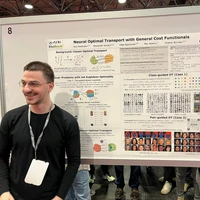
Neural Optimal Transport with General Cost Functionals
We introduce a novel neural network-based algorithm to compute optimal transport (OT) plans for general cost functionals. In contrast to common Euclidean costs, i.e., ell^1 or ell^2, such functionals provide more flexibility and allow using auxiliary information, such as class labels, to construct the required transport map. Existing methods for general costs are discrete and have limitations in practice, i.e. they do not provide an out-of-sample estimation. We address the challenge of designing a continuous OT approach for general costs that generalizes to new data points in high-dimensional spaces, such as images. Additionally, we provide the theoretical error analysis for our recovered transport plans. As an application, we construct a cost functional to map data distributions while preserving the class-wise structure.
Transforming Simulation to Data Without Pairing
We explore a generative machine learning-based approach for estimating multi-dimensional probability density functions (PDFs) in a target sample using a statistically independent but related control sample - a common challenge in particle physics data analysis. The generative model must accurately reproduce individual observable distributions while preserving the correlations between them, based on the input multidimensional distribution from the control sample. Here we present a conditional normalizing flow model (CNF) based on a chain of bijectors which learns to transform unpaired simulation events to data events. We assess the performance of the CNF model in the context of LHC Higgs to diphoton analysis, where we use the CNF model to convert a Monte Carlo diphoton sample to one that models data. We show that the CNF model can accurately model complex data distributions and correlations. We also leverage the recently popularized Modified Differential Multiplier Method (MDMM) to improve the convergence of our model and assign physical meaning to usually arbitrary loss-function parameters.
A Bregman firmly nonexpansive proximal operator for baryconvex optimization
We present a generalization of the proximal operator defined through a convex combination of convex objectives, where the coefficients are updated in a minimax fashion. We prove that this new operator is Bregman firmly nonexpansive with respect to a Bregman divergence that combines Euclidean and information geometries.

Off-Policy Primal-Dual Safe Reinforcement Learning
Primal-dual safe RL methods commonly perform iterations between the primal update of the policy and the dual update of the Lagrange Multiplier. Such a training paradigm is highly susceptible to the error in cumulative cost estimation since this estimation serves as the key bond connecting the primal and dual update processes. We show that this problem causes significant underestimation of cost when using off-policy methods, leading to the failure to satisfy the safety constraint. To address this issue, we propose conservative policy optimization, which learns a policy in a constraint-satisfying area by considering the uncertainty in cost estimation. This improves constraint satisfaction but also potentially hinders reward maximization. We then introduce local policy convexification to help eliminate such suboptimality by gradually reducing the estimation uncertainty. We provide theoretical interpretations of the joint coupling effect of these two ingredients and further verify them by extensive experiments. Results on benchmark tasks show that our method not only achieves an asymptotic performance comparable to state-of-the-art on-policy methods while using much fewer samples, but also significantly reduces constraint violation during training. Our code is available at https://github.com/ZifanWu/CAL.
Recovery Bounds on Class-Based Optimal Transport: A Sum-of-Norms Regularization Framework
We develop a novel theoretical framework for understating OT schemes respecting a class structure. For this purpose, we propose a convex OT program with a sum-of-norms regularization term, which provably recovers the underlying class structure under geometric assumptions. Furthermore, we derive an accelerated proximal algorithm with a closed-form projection and proximal operator scheme, thereby affording a more scalable algorithm for computing optimal transport plans. We provide a novel argument for the uniqueness of the optimum even in the absence of strong convexity. Our experiments show that the new regularizer not only results in a better preservation of the class structure in the data but also yields additional robustness to the data geometry, compared to previous regularizers.
Specializations of partial differential equations for Feynman integrals
Starting from the Mellin-Barnes integral representation of a Feynman integral depending on set of kinematic variables z_i, we derive a system of partial differential equations w.r.t.\ new variables x_j, which parameterize the differentiable constraints z_i=y_i(x_j). In our algorithm, the powers of propagators can be considered as arbitrary parameters. Our algorithm can also be used for the reduction of multiple hypergeometric sums to sums of lower dimension, finding special values and reduction equations of hypergeometric functions in a singular locus of continuous variables, or finding systems of partial differential equations for master integrals with arbitrary powers of propagators. As an illustration, we produce a differential equation of fourth order in one variable for the one-loop two-point Feynman diagram with two different masses and arbitrary propagator powers.
Lagrangian PINNs: A causality-conforming solution to failure modes of physics-informed neural networks
Physics-informed neural networks (PINNs) leverage neural-networks to find the solutions of partial differential equation (PDE)-constrained optimization problems with initial conditions and boundary conditions as soft constraints. These soft constraints are often considered to be the sources of the complexity in the training phase of PINNs. Here, we demonstrate that the challenge of training (i) persists even when the boundary conditions are strictly enforced, and (ii) is closely related to the Kolmogorov n-width associated with problems demonstrating transport, convection, traveling waves, or moving fronts. Given this realization, we describe the mechanism underlying the training schemes such as those used in eXtended PINNs (XPINN), curriculum regularization, and sequence-to-sequence learning. For an important category of PDEs, i.e., governed by non-linear convection-diffusion equation, we propose reformulating PINNs on a Lagrangian frame of reference, i.e., LPINNs, as a PDE-informed solution. A parallel architecture with two branches is proposed. One branch solves for the state variables on the characteristics, and the second branch solves for the low-dimensional characteristics curves. The proposed architecture conforms to the causality innate to the convection, and leverages the direction of travel of the information in the domain. Finally, we demonstrate that the loss landscapes of LPINNs are less sensitive to the so-called "complexity" of the problems, compared to those in the traditional PINNs in the Eulerian framework.
Information Shapes Koopman Representation
The Koopman operator provides a powerful framework for modeling dynamical systems and has attracted growing interest from the machine learning community. However, its infinite-dimensional nature makes identifying suitable finite-dimensional subspaces challenging, especially for deep architectures. We argue that these difficulties come from suboptimal representation learning, where latent variables fail to balance expressivity and simplicity. This tension is closely related to the information bottleneck (IB) dilemma: constructing compressed representations that are both compact and predictive. Rethinking Koopman learning through this lens, we demonstrate that latent mutual information promotes simplicity, yet an overemphasis on simplicity may cause latent space to collapse onto a few dominant modes. In contrast, expressiveness is sustained by the von Neumann entropy, which prevents such collapse and encourages mode diversity. This insight leads us to propose an information-theoretic Lagrangian formulation that explicitly balances this tradeoff. Furthermore, we propose a new algorithm based on the Lagrangian formulation that encourages both simplicity and expressiveness, leading to a stable and interpretable Koopman representation. Beyond quantitative evaluations, we further visualize the learned manifolds under our representations, observing empirical results consistent with our theoretical predictions. Finally, we validate our approach across a diverse range of dynamical systems, demonstrating improved performance over existing Koopman learning methods. The implementation is publicly available at https://github.com/Wenxuan52/InformationKoopman.

Jacobian Descent for Multi-Objective Optimization
Many optimization problems are inherently multi-objective. To address them, we formalize Jacobian descent (JD), a direct generalization of gradient descent for vector-valued functions. Each step of this algorithm relies on a Jacobian matrix consisting of one gradient per objective. The aggregator, responsible for reducing this matrix into an update vector, characterizes JD. While the multi-task learning literature already contains a variety of aggregators, they often lack some natural properties. In particular, the update should not conflict with any objective and should scale proportionally to the norm of each gradient. We propose a new aggregator specifically designed to satisfy this. Emphasizing conflict between objectives, we then highlight direct applications for our methods. Most notably, we introduce instance-wise risk minimization (IWRM), a learning paradigm in which the loss of each training example is considered a separate objective. On simple image classification tasks, IWRM exhibits promising results compared to the direct minimization of the average loss. The performance of our aggregator in those experiments also corroborates our theoretical findings. Lastly, as speed is the main limitation of JD, we provide a path towards a more efficient implementation.
The Monge Gap: A Regularizer to Learn All Transport Maps
Optimal transport (OT) theory has been been used in machine learning to study and characterize maps that can push-forward efficiently a probability measure onto another. Recent works have drawn inspiration from Brenier's theorem, which states that when the ground cost is the squared-Euclidean distance, the ``best'' map to morph a continuous measure in P(Rd) into another must be the gradient of a convex function. To exploit that result, [Makkuva+ 2020, Korotin+2020] consider maps T=nabla f_theta, where f_theta is an input convex neural network (ICNN), as defined by Amos+2017, and fit theta with SGD using samples. Despite their mathematical elegance, fitting OT maps with ICNNs raises many challenges, due notably to the many constraints imposed on theta; the need to approximate the conjugate of f_theta; or the limitation that they only work for the squared-Euclidean cost. More generally, we question the relevance of using Brenier's result, which only applies to densities, to constrain the architecture of candidate maps fitted on samples. Motivated by these limitations, we propose a radically different approach to estimating OT maps: Given a cost c and a reference measure rho, we introduce a regularizer, the Monge gap M^c_{rho}(T) of a map T. That gap quantifies how far a map T deviates from the ideal properties we expect from a c-OT map. In practice, we drop all architecture requirements for T and simply minimize a distance (e.g., the Sinkhorn divergence) between Tsharpmu and nu, regularized by M^c_rho(T). We study M^c_{rho}, and show how our simple pipeline outperforms significantly other baselines in practice.
The Optimiser Hidden in Plain Sight: Training with the Loss Landscape's Induced Metric
We present a class of novel optimisers for training neural networks that makes use of the Riemannian metric naturally induced when the loss landscape is embedded in higher-dimensional space. This is the same metric that underlies common visualisations of loss landscapes. By taking this geometric perspective literally and using the induced metric, we develop a new optimiser and compare it to existing methods, namely: SGD, Adam, AdamW, and Muon, across a range of tasks and architectures. Empirically, we conclude that this new class of optimisers is highly effective in low dimensional examples, and provides slight improvement over state-of-the-art methods for training neural networks. These new optimisers have theoretically desirable properties. In particular, the effective learning rate is automatically decreased in regions of high curvature acting as a smoothed out form of gradient clipping. Similarly, one variant of these optimisers can also be viewed as inducing an effective scheduled learning rate and decoupled weight decay is the natural choice from our geometric perspective. The basic method can be used to modify any existing preconditioning method. The new optimiser has a computational complexity comparable to that of Adam.
Lagrangian Coherent Track Initialisation (LCTI)
Advances in time-resolved Particle Tracking Velocimetry (4D-PTV) techniques have been consistently revealed more accurate Lagrangian particle motions. A novel track initialisation technique as a complementary part of 4D-PTV, based on local temporal and spatial coherency of neighbour trajectories, is proposed. The proposed Lagrangian Coherent Track Initialisation (LCTI) applies physics-based Finite Time Lyapunov Exponent (FTLE) to build four frame coherent tracks. We locally determine the boundaries (i.e., ridges) of Lagrangian Coherent Structures (LCS) among neighbour trajectories by using FTLE to distinguish clusters of coherent motions. To evaluate the proposed technique, we created an open-access synthetic Lagrangian and Eulerian dataset of the wake downstream of a smooth cylinder at a Reynolds number equal to 3900 obtained from 3D Direct Numerical Simulation (DNS). The dataset is available to the public. Performance of the proposed method based on three characteristic parameters, temporal scale, particle concentration (i.e., density), and noise ratio, showed robust behaviour in finding true tracks compared to the recent initialisation algorithms. Sensitivity of LCTI to the number of untracked and wrong tracks are also discussed. We address the capability of using the proposed method as a function of a 4D-PTV scheme in the Lagrangian Particle Tracking challenge for a flow with high particle densities. Finally, the LCTI behaviour was assessed in a real jet impingement experiment. LCTI was found to be a reliable tracking tool in complex flow motions, with a strength revealed for flows with high particle concentrations.

Multitask Gaussian Process with Hierarchical Latent Interactions
Multitask Gaussian process (MTGP) is powerful for joint learning of multiple tasks with complicated correlation patterns. However, due to the assembling of additive independent latent functions, all current MTGPs including the salient linear model of coregionalization (LMC) and convolution frameworks cannot effectively represent and learn the hierarchical latent interactions between its latent functions. In this paper, we further investigate the interactions in LMC of MTGP and then propose a novel kernel representation of the hierarchical interactions, which ameliorates both the expressiveness and the interpretability of MTGP. Specifically, we express the interaction as a product of function interaction and coefficient interaction. The function interaction is modeled by using cross convolution of latent functions. The coefficient interaction between the LMCs is described as a cross coregionalization term. We validate that considering the interactions can promote knowledge transferring in MTGP and compare our approach with some state-of-the-art MTGPs on both synthetic- and real-world datasets.
Rectified Flow: A Marginal Preserving Approach to Optimal Transport
We present a flow-based approach to the optimal transport (OT) problem between two continuous distributions pi_0,pi_1 on R^d, of minimizing a transport cost E[c(X_1-X_0)] in the set of couplings (X_0,X_1) whose marginal distributions on X_0,X_1 equals pi_0,pi_1, respectively, where c is a cost function. Our method iteratively constructs a sequence of neural ordinary differentiable equations (ODE), each learned by solving a simple unconstrained regression problem, which monotonically reduce the transport cost while automatically preserving the marginal constraints. This yields a monotonic interior approach that traverses inside the set of valid couplings to decrease the transport cost, which distinguishes itself from most existing approaches that enforce the coupling constraints from the outside. The main idea of the method draws from rectified flow, a recent approach that simultaneously decreases the whole family of transport costs induced by convex functions c (and is hence multi-objective in nature), but is not tailored to minimize a specific transport cost. Our method is a single-object variant of rectified flow that guarantees to solve the OT problem for a fixed, user-specified convex cost function c.
NeuralStagger: Accelerating Physics-constrained Neural PDE Solver with Spatial-temporal Decomposition
Neural networks have shown great potential in accelerating the solution of partial differential equations (PDEs). Recently, there has been a growing interest in introducing physics constraints into training neural PDE solvers to reduce the use of costly data and improve the generalization ability. However, these physics constraints, based on certain finite dimensional approximations over the function space, must resolve the smallest scaled physics to ensure the accuracy and stability of the simulation, resulting in high computational costs from large input, output, and neural networks. This paper proposes a general acceleration methodology called NeuralStagger by spatially and temporally decomposing the original learning tasks into several coarser-resolution subtasks. We define a coarse-resolution neural solver for each subtask, which requires fewer computational resources, and jointly train them with the vanilla physics-constrained loss by simply arranging their outputs to reconstruct the original solution. Due to the perfect parallelism between them, the solution is achieved as fast as a coarse-resolution neural solver. In addition, the trained solvers bring the flexibility of simulating with multiple levels of resolution. We demonstrate the successful application of NeuralStagger on 2D and 3D fluid dynamics simulations, which leads to an additional 10sim100times speed-up. Moreover, the experiment also shows that the learned model could be well used for optimal control.

TENG: Time-Evolving Natural Gradient for Solving PDEs With Deep Neural Nets Toward Machine Precision
Partial differential equations (PDEs) are instrumental for modeling dynamical systems in science and engineering. The advent of neural networks has initiated a significant shift in tackling these complexities though challenges in accuracy persist, especially for initial value problems. In this paper, we introduce the Time-Evolving Natural Gradient (TENG), generalizing time-dependent variational principles and optimization-based time integration, leveraging natural gradient optimization to obtain high accuracy in neural-network-based PDE solutions. Our comprehensive development includes algorithms like TENG-Euler and its high-order variants, such as TENG-Heun, tailored for enhanced precision and efficiency. TENG's effectiveness is further validated through its performance, surpassing current leading methods and achieving machine precision in step-by-step optimizations across a spectrum of PDEs, including the heat equation, Allen-Cahn equation, and Burgers' equation.

A Fully First-Order Method for Stochastic Bilevel Optimization
We consider stochastic unconstrained bilevel optimization problems when only the first-order gradient oracles are available. While numerous optimization methods have been proposed for tackling bilevel problems, existing methods either tend to require possibly expensive calculations regarding Hessians of lower-level objectives, or lack rigorous finite-time performance guarantees. In this work, we propose a Fully First-order Stochastic Approximation (F2SA) method, and study its non-asymptotic convergence properties. Specifically, we show that F2SA converges to an epsilon-stationary solution of the bilevel problem after epsilon^{-7/2}, epsilon^{-5/2}, and epsilon^{-3/2} iterations (each iteration using O(1) samples) when stochastic noises are in both level objectives, only in the upper-level objective, and not present (deterministic settings), respectively. We further show that if we employ momentum-assisted gradient estimators, the iteration complexities can be improved to epsilon^{-5/2}, epsilon^{-4/2}, and epsilon^{-3/2}, respectively. We demonstrate even superior practical performance of the proposed method over existing second-order based approaches on MNIST data-hypercleaning experiments.
ChainQueen: A Real-Time Differentiable Physical Simulator for Soft Robotics
Physical simulators have been widely used in robot planning and control. Among them, differentiable simulators are particularly favored, as they can be incorporated into gradient-based optimization algorithms that are efficient in solving inverse problems such as optimal control and motion planning. Simulating deformable objects is, however, more challenging compared to rigid body dynamics. The underlying physical laws of deformable objects are more complex, and the resulting systems have orders of magnitude more degrees of freedom and therefore they are significantly more computationally expensive to simulate. Computing gradients with respect to physical design or controller parameters is typically even more computationally challenging. In this paper, we propose a real-time, differentiable hybrid Lagrangian-Eulerian physical simulator for deformable objects, ChainQueen, based on the Moving Least Squares Material Point Method (MLS-MPM). MLS-MPM can simulate deformable objects including contact and can be seamlessly incorporated into inference, control and co-design systems. We demonstrate that our simulator achieves high precision in both forward simulation and backward gradient computation. We have successfully employed it in a diverse set of control tasks for soft robots, including problems with nearly 3,000 decision variables.

EquiNO: A Physics-Informed Neural Operator for Multiscale Simulations
Multiscale problems are ubiquitous in physics. Numerical simulations of such problems by solving partial differential equations (PDEs) at high resolution are computationally too expensive for many-query scenarios, e.g., uncertainty quantification, remeshing applications, topology optimization, and so forth. This limitation has motivated the application of data-driven surrogate models, where the microscale computations are substituted with a surrogate, usually acting as a black-box mapping between macroscale quantities. These models offer significant speedups but struggle with incorporating microscale physical constraints, such as the balance of linear momentum and constitutive models. In this contribution, we propose Equilibrium Neural Operator (EquiNO) as a complementary physics-informed PDE surrogate for predicting microscale physics and compare it with variational physics-informed neural and operator networks. Our framework, applicable to the so-called multiscale FE^{,2}, computations, introduces the FE-OL approach by integrating the finite element (FE) method with operator learning (OL). We apply the proposed FE-OL approach to quasi-static problems of solid mechanics. The results demonstrate that FE-OL can yield accurate solutions even when confronted with a restricted dataset during model development. Our results show that EquiNO achieves speedup factors exceeding 8000-fold compared to traditional methods and offers an optimal balance between data-driven and physics-based strategies.

Gradient-Normalized Smoothness for Optimization with Approximate Hessians
In this work, we develop new optimization algorithms that use approximate second-order information combined with the gradient regularization technique to achieve fast global convergence rates for both convex and non-convex objectives. The key innovation of our analysis is a novel notion called Gradient-Normalized Smoothness, which characterizes the maximum radius of a ball around the current point that yields a good relative approximation of the gradient field. Our theory establishes a natural intrinsic connection between Hessian approximation and the linearization of the gradient. Importantly, Gradient-Normalized Smoothness does not depend on the specific problem class of the objective functions, while effectively translating local information about the gradient field and Hessian approximation into the global behavior of the method. This new concept equips approximate second-order algorithms with universal global convergence guarantees, recovering state-of-the-art rates for functions with H\"older-continuous Hessians and third derivatives, quasi-self-concordant functions, as well as smooth classes in first-order optimization. These rates are achieved automatically and extend to broader classes, such as generalized self-concordant functions. We demonstrate direct applications of our results for global linear rates in logistic regression and softmax problems with approximate Hessians, as well as in non-convex optimization using Fisher and Gauss-Newton approximations.

Accelerated Infeasibility Detection of Constrained Optimization and Fixed-Point Iterations
As first-order optimization methods become the method of choice for solving large-scale optimization problems, optimization solvers based on first-order algorithms are being built. Such general-purpose solvers must robustly detect infeasible or misspecified problem instances, but the computational complexity of first-order methods for doing so has yet to be formally studied. In this work, we characterize the optimal accelerated rate of infeasibility detection. We show that the standard fixed-point iteration achieves a O(1/k^2) and O(1/k) rates, respectively, on the normalized iterates and the fixed-point residual converging to the infimal displacement vector, while the accelerated fixed-point iteration achieves O(1/k^2) and mathcal{O}(1/k^2) rates. We then provide a matching complexity lower bound to establish that Theta(1/k^2) is indeed the optimal accelerated rate.
MixPE: Quantization and Hardware Co-design for Efficient LLM Inference
Transformer-based large language models (LLMs) have achieved remarkable success as model sizes continue to grow, yet their deployment remains challenging due to significant computational and memory demands. Quantization has emerged as a promising solution, and state-of-the-art quantization algorithms for LLMs introduce the need for mixed-precision matrix multiplication (mpGEMM), where lower-precision weights are multiplied with higher-precision activations. Despite its benefits, current hardware accelerators such as GPUs and TPUs lack native support for efficient mpGEMM, leading to inefficient dequantization operations in the main sequential loop. To address this limitation, we introduce MixPE, a specialized mixed-precision processing element designed for efficient low-bit quantization in LLM inference. MixPE leverages two key innovations to minimize dequantization overhead and unlock the full potential of low-bit quantization. First, recognizing that scale and zero point are shared within each quantization group, we propose performing dequantization after per-group mpGEMM, significantly reducing dequantization overhead. Second, instead of relying on conventional multipliers, MixPE utilizes efficient shift\&add operations for multiplication, optimizing both computation and energy efficiency. Our experimental results demonstrate that MixPE surpasses the state-of-the-art quantization accelerators by 2.6times speedup and 1.4times energy reduction.

Simplifying Momentum-based Positive-definite Submanifold Optimization with Applications to Deep Learning
Riemannian submanifold optimization with momentum is computationally challenging because, to ensure that the iterates remain on the submanifold, we often need to solve difficult differential equations. Here, we simplify such difficulties for a class of structured symmetric positive-definite matrices with the affine-invariant metric. We do so by proposing a generalized version of the Riemannian normal coordinates that dynamically orthonormalizes the metric and locally converts the problem into an unconstrained problem in the Euclidean space. We use our approach to simplify existing approaches for structured covariances and develop matrix-inverse-free 2^nd-order optimizers for deep learning in low precision settings. Code: https://github.com/yorkerlin/StructuredNGD-DL

Stochastic Taylor Derivative Estimator: Efficient amortization for arbitrary differential operators
Optimizing neural networks with loss that contain high-dimensional and high-order differential operators is expensive to evaluate with back-propagation due to O(d^{k}) scaling of the derivative tensor size and the O(2^{k-1}L) scaling in the computation graph, where d is the dimension of the domain, L is the number of ops in the forward computation graph, and k is the derivative order. In previous works, the polynomial scaling in d was addressed by amortizing the computation over the optimization process via randomization. Separately, the exponential scaling in k for univariate functions (d=1) was addressed with high-order auto-differentiation (AD). In this work, we show how to efficiently perform arbitrary contraction of the derivative tensor of arbitrary order for multivariate functions, by properly constructing the input tangents to univariate high-order AD, which can be used to efficiently randomize any differential operator. When applied to Physics-Informed Neural Networks (PINNs), our method provides >1000times speed-up and >30times memory reduction over randomization with first-order AD, and we can now solve 1-million-dimensional PDEs in 8 minutes on a single NVIDIA A100 GPU. This work opens the possibility of using high-order differential operators in large-scale problems.
PFGM++: Unlocking the Potential of Physics-Inspired Generative Models
We introduce a new family of physics-inspired generative models termed PFGM++ that unifies diffusion models and Poisson Flow Generative Models (PFGM). These models realize generative trajectories for N dimensional data by embedding paths in N{+}D dimensional space while still controlling the progression with a simple scalar norm of the D additional variables. The new models reduce to PFGM when D{=}1 and to diffusion models when D{to}infty. The flexibility of choosing D allows us to trade off robustness against rigidity as increasing D results in more concentrated coupling between the data and the additional variable norms. We dispense with the biased large batch field targets used in PFGM and instead provide an unbiased perturbation-based objective similar to diffusion models. To explore different choices of D, we provide a direct alignment method for transferring well-tuned hyperparameters from diffusion models (D{to} infty) to any finite D values. Our experiments show that models with finite D can be superior to previous state-of-the-art diffusion models on CIFAR-10/FFHQ 64{times}64 datasets, with FID scores of 1.91/2.43 when D{=}2048/128. In class-conditional setting, D{=}2048 yields current state-of-the-art FID of 1.74 on CIFAR-10. In addition, we demonstrate that models with smaller D exhibit improved robustness against modeling errors. Code is available at https://github.com/Newbeeer/pfgmpp


MARS-M: When Variance Reduction Meets Matrices
Matrix-based preconditioned optimizers, such as Muon, have recently been shown to be more efficient than scalar-based optimizers for training large-scale neural networks, including large language models (LLMs). On the other hand, recent benchmarks on optimizers for LLM pre-training have demonstrated that variance-reduction techniques such as MARS can achieve substantial speedups over standard optimizers that do not employ variance reduction. In this paper, to achieve the best of both worlds, we introduce MARS-M, a new optimizer that integrates the variance reduction technique in MARS with Muon. Under standard regularity conditions, we prove that Muon-M converges to a first-order stationary point at a rate of mathcal{O}(T^{-1/3}), which improves upon mathcal{O}(T^{-1/4}) rate attained by Muon. Our empirical results on language modeling and computer vision tasks demonstrate that MARS-M consistently yields lower losses and improved performance across various downstream benchmarks. The implementation of MARS-M is available at https://github.com/AGI-Arena/MARS/MARS_M.

Damped Newton Method with Near-Optimal Global Oleft(k^{-3} right) Convergence Rate
This paper investigates the global convergence of stepsized Newton methods for convex functions. We propose several simple stepsize schedules with fast global convergence guarantees, up to O (k^{-3}), nearly matching lower complexity bounds Omega (k^{-3.5}) of second-order methods. For cases with multiple plausible smoothness parameterizations or an unknown smoothness constant, we introduce a stepsize backtracking procedure that ensures convergence as if the optimal smoothness parameters were known.

Optimal Stochastic Non-smooth Non-convex Optimization through Online-to-Non-convex Conversion
We present new algorithms for optimizing non-smooth, non-convex stochastic objectives based on a novel analysis technique. This improves the current best-known complexity for finding a (delta,epsilon)-stationary point from O(epsilon^{-4}delta^{-1}) stochastic gradient queries to O(epsilon^{-3}delta^{-1}), which we also show to be optimal. Our primary technique is a reduction from non-smooth non-convex optimization to online learning, after which our results follow from standard regret bounds in online learning. For deterministic and second-order smooth objectives, applying more advanced optimistic online learning techniques enables a new complexity of O(epsilon^{-1.5}delta^{-0.5}). Our techniques also recover all optimal or best-known results for finding epsilon stationary points of smooth or second-order smooth objectives in both stochastic and deterministic settings.

Taylor Expansion Policy Optimization
In this work, we investigate the application of Taylor expansions in reinforcement learning. In particular, we propose Taylor expansion policy optimization, a policy optimization formalism that generalizes prior work (e.g., TRPO) as a first-order special case. We also show that Taylor expansions intimately relate to off-policy evaluation. Finally, we show that this new formulation entails modifications which improve the performance of several state-of-the-art distributed algorithms.

Riemannian Adaptive Optimization Methods
Several first order stochastic optimization methods commonly used in the Euclidean domain such as stochastic gradient descent (SGD), accelerated gradient descent or variance reduced methods have already been adapted to certain Riemannian settings. However, some of the most popular of these optimization tools - namely Adam , Adagrad and the more recent Amsgrad - remain to be generalized to Riemannian manifolds. We discuss the difficulty of generalizing such adaptive schemes to the most agnostic Riemannian setting, and then provide algorithms and convergence proofs for geodesically convex objectives in the particular case of a product of Riemannian manifolds, in which adaptivity is implemented across manifolds in the cartesian product. Our generalization is tight in the sense that choosing the Euclidean space as Riemannian manifold yields the same algorithms and regret bounds as those that were already known for the standard algorithms. Experimentally, we show faster convergence and to a lower train loss value for Riemannian adaptive methods over their corresponding baselines on the realistic task of embedding the WordNet taxonomy in the Poincare ball.
Reverse derivative categories
The reverse derivative is a fundamental operation in machine learning and automatic differentiation. This paper gives a direct axiomatization of a category with a reverse derivative operation, in a similar style to that given by Cartesian differential categories for a forward derivative. Intriguingly, a category with a reverse derivative also has a forward derivative, but the converse is not true. In fact, we show explicitly what a forward derivative is missing: a reverse derivative is equivalent to a forward derivative with a dagger structure on its subcategory of linear maps. Furthermore, we show that these linear maps form an additively enriched category with dagger biproducts.
Eulerian-Lagrangian particle-based model for diffusional growth for the better parameterization of ISM clouds: A road map for improving climate model through small-scale model using observations
The quantitative prediction of the intensity of rainfall events (light or heavy) has remained a challenge in Numerical Weather Prediction (NWP) models. For the first time the mean coefficient of diffusional growth rates are calculated using an Eulerian-Lagrangian particle-based small-scale model on in situ airborne measurement data of Cloud Aerosol Interaction and Precipitation Enhancement Experiment (CAIPEEX) during monsoon over Indian sub-continent. The results show that diffusional growth rates varies in the range of 0.00025 - 0.0015(cm/s). The generic problem of the overestimation of light rain in NWP models might be related with the choice of cm in the model. It is also shown from DNS experiment using Eulerian-Lagrangian particle-based small-scale model that the relative dispersion is constrained with average values in the range of ~ 0.2 - 0.37 (~ 0.1- 0.26) in less humid (more humid) conditions. This is in agreement with in situ airborne observation (dispersion ~ 0.36) and previous study over Indian sub-continent. The linear relationship between relative dispersion and cloud droplet number concentration (NC) is obtained from this study using CAIPEEX observation over Indian subcontinent. The dispersion based autoconversion-scheme for Indian region must be useful for the Indian summer monsoon precipitation calculation in the general circulation model. The present study also provide valuable guidance for the parameterization of effective radius, important for radiation scheme.
An Informal Introduction to Multiplet Neural Networks
In the artificial neuron, I replace the dot product with the weighted Lehmer mean, which may emulate different cases of a generalized mean. The single neuron instance is replaced by a multiplet of neurons which have the same averaging weights. A group of outputs feed forward, in lieu of the single scalar. The generalization parameter is typically set to a different value for each neuron in the multiplet. I further extend the concept to a multiplet taken from the Gini mean. Derivatives with respect to the weight parameters and with respect to the two generalization parameters are given. Some properties of the network are investigated, showing the capacity to emulate the classical exclusive-or problem organically in two layers and perform some multiplication and division. The network can instantiate truncated power series and variants, which can be used to approximate different functions, provided that parameters are constrained. Moreover, a mean case slope score is derived that can facilitate a learning-rate novelty based on homogeneity of the selected elements. The multiplet neuron equation provides a way to segment regularization timeframes and approaches.

Synergistic Learning with Multi-Task DeepONet for Efficient PDE Problem Solving
Multi-task learning (MTL) is an inductive transfer mechanism designed to leverage useful information from multiple tasks to improve generalization performance compared to single-task learning. It has been extensively explored in traditional machine learning to address issues such as data sparsity and overfitting in neural networks. In this work, we apply MTL to problems in science and engineering governed by partial differential equations (PDEs). However, implementing MTL in this context is complex, as it requires task-specific modifications to accommodate various scenarios representing different physical processes. To this end, we present a multi-task deep operator network (MT-DeepONet) to learn solutions across various functional forms of source terms in a PDE and multiple geometries in a single concurrent training session. We introduce modifications in the branch network of the vanilla DeepONet to account for various functional forms of a parameterized coefficient in a PDE. Additionally, we handle parameterized geometries by introducing a binary mask in the branch network and incorporating it into the loss term to improve convergence and generalization to new geometry tasks. Our approach is demonstrated on three benchmark problems: (1) learning different functional forms of the source term in the Fisher equation; (2) learning multiple geometries in a 2D Darcy Flow problem and showcasing better transfer learning capabilities to new geometries; and (3) learning 3D parameterized geometries for a heat transfer problem and demonstrate the ability to predict on new but similar geometries. Our MT-DeepONet framework offers a novel approach to solving PDE problems in engineering and science under a unified umbrella based on synergistic learning that reduces the overall training cost for neural operators.

Hybrid Learning and Optimization methods for solving Capacitated Vehicle Routing Problem
The Capacitated Vehicle Routing Problem (CVRP) is a fundamental NP-hard problem in logistics. Augmented Lagrangian Methods (ALM) for solving CVRP performance depends heavily on well-tuned penalty parameters. In this paper, we propose a hybrid optimization approach that integrates deep reinforcement learning (RL) to automate the selection of penalty parameter values within both classical (RL-C-ALM) and quantum-enhanced (RL-Q-ALM) ALM solvers. Using Soft Actor-Critic, our approach learns penalty values from CVRP instance features and constraint violations. In RL-Q-ALM, subproblems are encoded as QUBOs and solved using Variational Quantum Eigensolvers (VQE). The agent learns across episodes by maximizing solution feasibility and minimizing cost. Experiments show that RL-C-ALM outperforms manually tuned ALM on synthetic and benchmark CVRP instances, achieving better solutions with fewer iterations. Also, RL-Q-ALM matches classical solution quality on small instances but incurs higher runtimes due to quantum overhead. Our results highlight the potential of combining RL with classical and quantum solvers for scalable, adaptive combinatorial optimization.
Dale meets Langevin: A Multiplicative Denoising Diffusion Model
Gradient descent has proven to be a powerful and effective technique for optimization in numerous machine learning applications. Recent advances in computational neuroscience have shown that learning in standard gradient descent optimization formulation is not consistent with learning in biological systems. This has opened up interesting avenues for building biologically inspired learning techniques. One such approach is inspired by Dale's law, which states that inhibitory and excitatory synapses do not swap roles during the course of learning. The resulting exponential gradient descent optimization scheme leads to log-normally distributed synaptic weights. Interestingly, the density that satisfies the Fokker-Planck equation corresponding to the stochastic differential equation (SDE) with geometric Brownian motion (GBM) is the log-normal density. Leveraging this connection, we start with the SDE governing geometric Brownian motion, and show that discretizing the corresponding reverse-time SDE yields a multiplicative update rule, which surprisingly, coincides with the sampling equivalent of the exponential gradient descent update founded on Dale's law. Furthermore, we propose a new formalism for multiplicative denoising score-matching, subsuming the loss function proposed by Hyvaerinen for non-negative data. Indeed, log-normally distributed data is positive and the proposed score-matching formalism turns out to be a natural fit. This allows for training of score-based models for image data and results in a novel multiplicative update scheme for sample generation starting from a log-normal density. Experimental results on MNIST, Fashion MNIST, and Kuzushiji datasets demonstrate generative capability of the new scheme. To the best of our knowledge, this is the first instance of a biologically inspired generative model employing multiplicative updates, founded on geometric Brownian motion.

Generalized Munchausen Reinforcement Learning using Tsallis KL Divergence
Many policy optimization approaches in reinforcement learning incorporate a Kullback-Leilbler (KL) divergence to the previous policy, to prevent the policy from changing too quickly. This idea was initially proposed in a seminal paper on Conservative Policy Iteration, with approximations given by algorithms like TRPO and Munchausen Value Iteration (MVI). We continue this line of work by investigating a generalized KL divergence -- called the Tsallis KL divergence -- which use the q-logarithm in the definition. The approach is a strict generalization, as q = 1 corresponds to the standard KL divergence; q > 1 provides a range of new options. We characterize the types of policies learned under the Tsallis KL, and motivate when q >1 could be beneficial. To obtain a practical algorithm that incorporates Tsallis KL regularization, we extend MVI, which is one of the simplest approaches to incorporate KL regularization. We show that this generalized MVI(q) obtains significant improvements over the standard MVI(q = 1) across 35 Atari games.
From Optimization Dynamics to Generalization Bounds via Łojasiewicz Gradient Inequality
Optimization and generalization are two essential aspects of statistical machine learning. In this paper, we propose a framework to connect optimization with generalization by analyzing the generalization error based on the optimization trajectory under the gradient flow algorithm. The key ingredient of this framework is the Uniform-LGI, a property that is generally satisfied when training machine learning models. Leveraging the Uniform-LGI, we first derive convergence rates for gradient flow algorithm, then we give generalization bounds for a large class of machine learning models. We further apply our framework to three distinct machine learning models: linear regression, kernel regression, and two-layer neural networks. Through our approach, we obtain generalization estimates that match or extend previous results.

Mass corrections to the DGLAP equations
We propose a mass-dependent MOM scheme to renormalize UV divergence of unpolarized PDFs at one-loop order. This approach which is based on a once subtracted dispersion relation does not need any regulator. The overall counterterms are obtained from the imaginary part of large transverse momentum region in loop integrals. The mass-dependent characteristic of the scheme yields to mass-dependent splitting functions for the DGLAP evolution equations. While the flavor number is fixed at any renormalization scale, the decoupling theorem is automatically imposed by the mass-dependent splitting functions. The required symmetries are also automatically respected by our prescription.
DyMixOp: Guiding Neural Operator Design for PDEs from a Complex Dynamics Perspective with Local-Global-Mixing
A primary challenge in using neural networks to approximate nonlinear dynamical systems governed by partial differential equations (PDEs) is transforming these systems into a suitable format, especially when dealing with non-linearizable dynamics or the need for infinite-dimensional spaces for linearization. This paper introduces DyMixOp, a novel neural operator framework for PDEs that integrates insights from complex dynamical systems to address this challenge. Grounded in inertial manifold theory, DyMixOp transforms infinite-dimensional nonlinear PDE dynamics into a finite-dimensional latent space, establishing a structured foundation that maintains essential nonlinear interactions and enhances physical interpretability. A key innovation is the Local-Global-Mixing (LGM) transformation, inspired by convection dynamics in turbulence. This transformation effectively captures both fine-scale details and nonlinear interactions, while mitigating spectral bias commonly found in existing neural operators. The framework is further strengthened by a dynamics-informed architecture that connects multiple LGM layers to approximate linear and nonlinear dynamics, reflecting the temporal evolution of dynamical systems. Experimental results across diverse PDE benchmarks demonstrate that DyMixOp achieves state-of-the-art performance, significantly reducing prediction errors, particularly in convection-dominated scenarios reaching up to 86.7\%, while maintaining computational efficiency and scalability.
μLO: Compute-Efficient Meta-Generalization of Learned Optimizers
Learned optimizers (LOs) can significantly reduce the wall-clock training time of neural networks, substantially reducing training costs. However, they often suffer from poor meta-generalization, especially when training networks larger than those seen during meta-training. To address this, we use the recently proposed Maximal Update Parametrization (muP), which allows zero-shot generalization of optimizer hyperparameters from smaller to larger models. We extend muP theory to learned optimizers, treating the meta-training problem as finding the learned optimizer under muP. Our evaluation shows that LOs meta-trained with muP substantially improve meta-generalization as compared to LOs trained under standard parametrization (SP). Notably, when applied to large-width models, our best muLO, trained for 103 GPU-hours, matches or exceeds the performance of VeLO, the largest publicly available learned optimizer, meta-trained with 4000 TPU-months of compute. Moreover, muLOs demonstrate better generalization than their SP counterparts to deeper networks and to much longer training horizons (25 times longer) than those seen during meta-training.




Better Training of GFlowNets with Local Credit and Incomplete Trajectories
Generative Flow Networks or GFlowNets are related to Monte-Carlo Markov chain methods (as they sample from a distribution specified by an energy function), reinforcement learning (as they learn a policy to sample composed objects through a sequence of steps), generative models (as they learn to represent and sample from a distribution) and amortized variational methods (as they can be used to learn to approximate and sample from an otherwise intractable posterior, given a prior and a likelihood). They are trained to generate an object x through a sequence of steps with probability proportional to some reward function R(x) (or exp(-E(x)) with E(x) denoting the energy function), given at the end of the generative trajectory. Like for other RL settings where the reward is only given at the end, the efficiency of training and credit assignment may suffer when those trajectories are longer. With previous GFlowNet work, no learning was possible from incomplete trajectories (lacking a terminal state and the computation of the associated reward). In this paper, we consider the case where the energy function can be applied not just to terminal states but also to intermediate states. This is for example achieved when the energy function is additive, with terms available along the trajectory. We show how to reparameterize the GFlowNet state flow function to take advantage of the partial reward already accrued at each state. This enables a training objective that can be applied to update parameters even with incomplete trajectories. Even when complete trajectories are available, being able to obtain more localized credit and gradients is found to speed up training convergence, as demonstrated across many simulations.


Accelerated Cyclic Coordinate Dual Averaging with Extrapolation for Composite Convex Optimization
Exploiting partial first-order information in a cyclic way is arguably the most natural strategy to obtain scalable first-order methods. However, despite their wide use in practice, cyclic schemes are far less understood from a theoretical perspective than their randomized counterparts. Motivated by a recent success in analyzing an extrapolated cyclic scheme for generalized variational inequalities, we propose an Accelerated Cyclic Coordinate Dual Averaging with Extrapolation (A-CODER) method for composite convex optimization, where the objective function can be expressed as the sum of a smooth convex function accessible via a gradient oracle and a convex, possibly nonsmooth, function accessible via a proximal oracle. We show that A-CODER attains the optimal convergence rate with improved dependence on the number of blocks compared to prior work. Furthermore, for the setting where the smooth component of the objective function is expressible in a finite sum form, we introduce a variance-reduced variant of A-CODER, VR-A-CODER, with state-of-the-art complexity guarantees. Finally, we demonstrate the effectiveness of our algorithms through numerical experiments.
Primal and Dual Analysis of Entropic Fictitious Play for Finite-sum Problems
The entropic fictitious play (EFP) is a recently proposed algorithm that minimizes the sum of a convex functional and entropy in the space of measures -- such an objective naturally arises in the optimization of a two-layer neural network in the mean-field regime. In this work, we provide a concise primal-dual analysis of EFP in the setting where the learning problem exhibits a finite-sum structure. We establish quantitative global convergence guarantees for both the continuous-time and discrete-time dynamics based on properties of a proximal Gibbs measure introduced in Nitanda et al. (2022). Furthermore, our primal-dual framework entails a memory-efficient particle-based implementation of the EFP update, and also suggests a connection to gradient boosting methods. We illustrate the efficiency of our novel implementation in experiments including neural network optimization and image synthesis.
Grams: Gradient Descent with Adaptive Momentum Scaling
We introduce Gradient Descent with Adaptive Momentum Scaling (Grams), a novel optimization algorithm that decouples the direction and magnitude of parameter updates in deep learning. Unlike traditional optimizers that directly integrate momentum into updates, Grams separates the update direction, derived from current gradients, from momentum, which is used solely for adaptive magnitude scaling. This approach enables Grams to achieve improved loss descent compared to state-of-the-art cautious and momentum-based optimizers. We establish a global convergence guarantee for Grams and validate its effectiveness through extensive empirical evaluations. The results demonstrate Grams' superior performance, including faster convergence and better generalization, compared to widely-used optimizers such as Adam, Lion, and their cautious variants. Our results highlight Grams' potential as a transformative approach for efficient optimization in large-scale machine learning.


Stein Variational Goal Generation for adaptive Exploration in Multi-Goal Reinforcement Learning
In multi-goal Reinforcement Learning, an agent can share experience between related training tasks, resulting in better generalization for new tasks at test time. However, when the goal space has discontinuities and the reward is sparse, a majority of goals are difficult to reach. In this context, a curriculum over goals helps agents learn by adapting training tasks to their current capabilities. In this work we propose Stein Variational Goal Generation (SVGG), which samples goals of intermediate difficulty for the agent, by leveraging a learned predictive model of its goal reaching capabilities. The distribution of goals is modeled with particles that are attracted in areas of appropriate difficulty using Stein Variational Gradient Descent. We show that SVGG outperforms state-of-the-art multi-goal Reinforcement Learning methods in terms of success coverage in hard exploration problems, and demonstrate that it is endowed with a useful recovery property when the environment changes.

Cautious Optimizers: Improving Training with One Line of Code
AdamW has been the default optimizer for transformer pretraining. For many years, our community searches for faster and more stable optimizers with only constraint positive outcomes. In this work, we propose a single-line modification in Pytorch to any momentum-based optimizer, which we rename Cautious Optimizer, e.g. C-AdamW and C-Lion. Our theoretical result shows that this modification preserves Adam's Hamiltonian function and it does not break the convergence guarantee under the Lyapunov analysis. In addition, a whole new family of optimizers is revealed by our theoretical insight. Among them, we pick the simplest one for empirical experiments, showing speed-up on Llama and MAE pretraining up to 1.47times. Code is available at https://github.com/kyleliang919/C-Optim



Enabling Efficient Equivariant Operations in the Fourier Basis via Gaunt Tensor Products
Developing equivariant neural networks for the E(3) group plays an important role in modeling 3D data across real-world applications. Enforcing this equivariance primarily involves the tensor products of irreducible representations (irreps). However, the computational complexity of such operations increases significantly as higher-order tensors are used. In this work, we propose a systematic approach to substantially accelerate the computation of the tensor products of irreps. We mathematically connect the commonly used Clebsch-Gordan coefficients to the Gaunt coefficients, which are integrals of products of three spherical harmonics. Through Gaunt coefficients, the tensor product of irreps becomes equivalent to the multiplication between spherical functions represented by spherical harmonics. This perspective further allows us to change the basis for the equivariant operations from spherical harmonics to a 2D Fourier basis. Consequently, the multiplication between spherical functions represented by a 2D Fourier basis can be efficiently computed via the convolution theorem and Fast Fourier Transforms. This transformation reduces the complexity of full tensor products of irreps from O(L^6) to O(L^3), where L is the max degree of irreps. Leveraging this approach, we introduce the Gaunt Tensor Product, which serves as a new method to construct efficient equivariant operations across different model architectures. Our experiments on the Open Catalyst Project and 3BPA datasets demonstrate both the increased efficiency and improved performance of our approach.
Adversarial Classification: Necessary conditions and geometric flows
We study a version of adversarial classification where an adversary is empowered to corrupt data inputs up to some distance varepsilon, using tools from variational analysis. In particular, we describe necessary conditions associated with the optimal classifier subject to such an adversary. Using the necessary conditions, we derive a geometric evolution equation which can be used to track the change in classification boundaries as varepsilon varies. This evolution equation may be described as an uncoupled system of differential equations in one dimension, or as a mean curvature type equation in higher dimension. In one dimension, and under mild assumptions on the data distribution, we rigorously prove that one can use the initial value problem starting from varepsilon=0, which is simply the Bayes classifier, in order to solve for the global minimizer of the adversarial problem for small values of varepsilon. In higher dimensions we provide a similar result, albeit conditional to the existence of regular solutions of the initial value problem. In the process of proving our main results we obtain a result of independent interest connecting the original adversarial problem with an optimal transport problem under no assumptions on whether classes are balanced or not. Numerical examples illustrating these ideas are also presented.
General teleparallel geometric theory of defects
We revisit the geometric theory of defects. In the differential-geometric models of defects that have been adopted since the 1950s, dislocations have been associated with torsion, disclinations with the full curvature, and point defects with the first kind trace of non-metricity. The mainstream formulation exhibits several conceptual and technical shortcomings, most notably a hierarchy inconsistency, the non-exictence of a genuine metric formulation, and the potential emergence of Ostrogradsky-type instabilities. These issues have motivated us to develop a new framework, namely a generalized teleparallel geometric theory of defects. In our model, dislocations are identified with the trace of torsion, disclinations with the second kind trace of the non-metricity, and point defects with the first kind trace of the non-metricity. In addition, we retain the scalar part torsion as a free parameter for describing some possible unknown degrees of freedom in the theory of defects. The proposed geometric theory of defects is free from all of the aforementioned drawbacks and is therefore worthy of further investigation. To ensure the coherence and completeness of the discussion, we begin our analysis with elastic deformations, then summarize the existing metric-affine geometric theory of defects, and finally proceed to our original contribution, namely the new theory introduced here. We formulate the entire theory in Eulerian coordinates. Naturally, all results can be reformulated in Lagrangian coordinates as well. All analyses and formulae are expressed in the language of exterior algebra and are carried out in coordinate-independent orthonormal frames.
Sparsity-Constrained Optimal Transport
Regularized optimal transport (OT) is now increasingly used as a loss or as a matching layer in neural networks. Entropy-regularized OT can be computed using the Sinkhorn algorithm but it leads to fully-dense transportation plans, meaning that all sources are (fractionally) matched with all targets. To address this issue, several works have investigated quadratic regularization instead. This regularization preserves sparsity and leads to unconstrained and smooth (semi) dual objectives, that can be solved with off-the-shelf gradient methods. Unfortunately, quadratic regularization does not give direct control over the cardinality (number of nonzeros) of the transportation plan. We propose in this paper a new approach for OT with explicit cardinality constraints on the transportation plan. Our work is motivated by an application to sparse mixture of experts, where OT can be used to match input tokens such as image patches with expert models such as neural networks. Cardinality constraints ensure that at most k tokens are matched with an expert, which is crucial for computational performance reasons. Despite the nonconvexity of cardinality constraints, we show that the corresponding (semi) dual problems are tractable and can be solved with first-order gradient methods. Our method can be thought as a middle ground between unregularized OT (recovered in the limit case k=1) and quadratically-regularized OT (recovered when k is large enough). The smoothness of the objectives increases as k increases, giving rise to a trade-off between convergence speed and sparsity of the optimal plan.

Training Neural Networks in Single vs Double Precision
The commitment to single-precision floating-point arithmetic is widespread in the deep learning community. To evaluate whether this commitment is justified, the influence of computing precision (single and double precision) on the optimization performance of the Conjugate Gradient (CG) method (a second-order optimization algorithm) and RMSprop (a first-order algorithm) has been investigated. Tests of neural networks with one to five fully connected hidden layers and moderate or strong nonlinearity with up to 4 million network parameters have been optimized for Mean Square Error (MSE). The training tasks have been set up so that their MSE minimum was known to be zero. Computing experiments have disclosed that single-precision can keep up (with superlinear convergence) with double-precision as long as line search finds an improvement. First-order methods such as RMSprop do not benefit from double precision. However, for moderately nonlinear tasks, CG is clearly superior. For strongly nonlinear tasks, both algorithm classes find only solutions fairly poor in terms of mean square error as related to the output variance. CG with double floating-point precision is superior whenever the solutions have the potential to be useful for the application goal.

An open-closed Deligne-Mumford field theory associated to a Lagrangian submanifold
Let L subset X be a compact embedded Lagrangian in a compact symplectic manifold. We present the moduli spaces of holomorphic maps of arbitrary genus with boundary on L as a global Kuranishi chart, generalising the work of Abouzaid-McLean-Smith and Hirschi-Swaminathan. We use this to define an open-closed Deligne-Mumford theory whose open genus zero part is the Fukaya A_infty algebra associated to L, and whose closed part gives the Gromov--Witten theory of X. Combined with results of Costello, this has applications in obtaining Gromov--Witten invariants from the Fukaya category.
Target-based Surrogates for Stochastic Optimization
We consider minimizing functions for which it is expensive to compute the (possibly stochastic) gradient. Such functions are prevalent in reinforcement learning, imitation learning and adversarial training. Our target optimization framework uses the (expensive) gradient computation to construct surrogate functions in a target space (e.g. the logits output by a linear model for classification) that can be minimized efficiently. This allows for multiple parameter updates to the model, amortizing the cost of gradient computation. In the full-batch setting, we prove that our surrogate is a global upper-bound on the loss, and can be (locally) minimized using a black-box optimization algorithm. We prove that the resulting majorization-minimization algorithm ensures convergence to a stationary point of the loss. Next, we instantiate our framework in the stochastic setting and propose the SSO algorithm, which can be viewed as projected stochastic gradient descent in the target space. This connection enables us to prove theoretical guarantees for SSO when minimizing convex functions. Our framework allows the use of standard stochastic optimization algorithms to construct surrogates which can be minimized by any deterministic optimization method. To evaluate our framework, we consider a suite of supervised learning and imitation learning problems. Our experiments indicate the benefits of target optimization and the effectiveness of SSO.

Turbo-Muon: Accelerating Orthogonality-Based Optimization with Pre-Conditioning
Orthogonality-based optimizers, such as Muon, have recently shown strong performance across large-scale training and community-driven efficiency challenges. However, these methods rely on a costly gradient orthogonalization step. Even efficient iterative approximations such as Newton-Schulz remain expensive, typically requiring dozens of matrix multiplications to converge. We introduce a preconditioning procedure that accelerates Newton-Schulz convergence and reduces its computational cost. We evaluate its impact and show that the overhead of our preconditioning can be made negligible. Furthermore, the faster convergence it enables allows us to remove one iteration out of the usual five without degrading approximation quality. Our publicly available implementation achieves up to a 2.8x speedup in the Newton-Schulz approximation. We also show that this has a direct impact on end-to-end training runtime with 5-10% improvement in realistic training scenarios across two efficiency-focused tasks. On challenging language or vision tasks, we validate that our method maintains equal or superior model performance while improving runtime. Crucially, these improvements require no hyperparameter tuning and can be adopted as a simple drop-in replacement. Our code is publicly available on github.
Leverage the Average: an Analysis of KL Regularization in RL
Recent Reinforcement Learning (RL) algorithms making use of Kullback-Leibler (KL) regularization as a core component have shown outstanding performance. Yet, only little is understood theoretically about why KL regularization helps, so far. We study KL regularization within an approximate value iteration scheme and show that it implicitly averages q-values. Leveraging this insight, we provide a very strong performance bound, the very first to combine two desirable aspects: a linear dependency to the horizon (instead of quadratic) and an error propagation term involving an averaging effect of the estimation errors (instead of an accumulation effect). We also study the more general case of an additional entropy regularizer. The resulting abstract scheme encompasses many existing RL algorithms. Some of our assumptions do not hold with neural networks, so we complement this theoretical analysis with an extensive empirical study.

Optimal design of plane elastic membranes using the convexified Föppl's model
This work puts forth a new optimal design formulation for planar elastic membranes. The goal is to minimize the membrane's compliance through choosing the material distribution described by a positive Radon measure. The deformation of the membrane itself is governed by the convexified F\"{o}ppl's model. The uniqueness of this model lies in the convexity of its variational formulation despite the inherent nonlinearity of the strain-displacement relation. It makes it possible to rewrite the optimization problem as a pair of mutually dual convex variational problems. In the primal problem a linear functional is maximized with respect to displacement functions while enforcing that point-wisely the strain lies in an unbounded closed convex set. The dual problem consists in finding equilibrated stresses that are to minimize a convex integral functional of linear growth defined on the space of Radon measures. The pair of problems is analysed: existence and regularity results are provided, together with the system of optimality criteria. To demonstrate the computational potential of the pair, a finite element scheme is developed around it. Upon reformulation to a conic-quadratic & semi-definite programming problem, the method is employed to produce numerical simulations for several load case scenarios.
Light Schrödinger Bridge
Despite the recent advances in the field of computational Schr\"odinger Bridges (SB), most existing SB solvers are still heavy-weighted and require complex optimization of several neural networks. It turns out that there is no principal solver which plays the role of simple-yet-effective baseline for SB just like, e.g., k-means method in clustering, logistic regression in classification or Sinkhorn algorithm in discrete optimal transport. We address this issue and propose a novel fast and simple SB solver. Our development is a smart combination of two ideas which recently appeared in the field: (a) parameterization of the Schr\"odinger potentials with sum-exp quadratic functions and (b) viewing the log-Schr\"odinger potentials as the energy functions. We show that combined together these ideas yield a lightweight, simulation-free and theoretically justified SB solver with a simple straightforward optimization objective. As a result, it allows solving SB in moderate dimensions in a matter of minutes on CPU without a painful hyperparameter selection. Our light solver resembles the Gaussian mixture model which is widely used for density estimation. Inspired by this similarity, we also prove an important theoretical result showing that our light solver is a universal approximator of SBs. Furthemore, we conduct the analysis of the generalization error of our light solver. The code for our solver can be found at https://github.com/ngushchin/LightSB

Lagrangian basis method for dimensionality reduction of convection dominated nonlinear flows
Foundations of a new projection-based model reduction approach for convection dominated nonlinear fluid flows are summarized. In this method the evolution of the flow is approximated in the Lagrangian frame of reference. Global basis functions are used to approximate both the state and the position of the Lagrangian computational domain. It is demonstrated that in this framework, certain wave-like solutions exhibit low-rank structure and thus, can be efficiently compressed using relatively few global basis. The proposed approach is successfully demonstrated for the reduction of several simple but representative problems.
Better Neural PDE Solvers Through Data-Free Mesh Movers
Recently, neural networks have been extensively employed to solve partial differential equations (PDEs) in physical system modeling. While major studies focus on learning system evolution on predefined static mesh discretizations, some methods utilize reinforcement learning or supervised learning techniques to create adaptive and dynamic meshes, due to the dynamic nature of these systems. However, these approaches face two primary challenges: (1) the need for expensive optimal mesh data, and (2) the change of the solution space's degree of freedom and topology during mesh refinement. To address these challenges, this paper proposes a neural PDE solver with a neural mesh adapter. To begin with, we introduce a novel data-free neural mesh adaptor, called Data-free Mesh Mover (DMM), with two main innovations. Firstly, it is an operator that maps the solution to adaptive meshes and is trained using the Monge-Amp\`ere equation without optimal mesh data. Secondly, it dynamically changes the mesh by moving existing nodes rather than adding or deleting nodes and edges. Theoretical analysis shows that meshes generated by DMM have the lowest interpolation error bound. Based on DMM, to efficiently and accurately model dynamic systems, we develop a moving mesh based neural PDE solver (MM-PDE) that embeds the moving mesh with a two-branch architecture and a learnable interpolation framework to preserve information within the data. Empirical experiments demonstrate that our method generates suitable meshes and considerably enhances accuracy when modeling widely considered PDE systems. The code can be found at: https://github.com/Peiyannn/MM-PDE.git.

The discrete generalized exchange-driven system
We study a discrete model for generalized exchange-driven growth in which the particle exchanged between two clusters is not limited to be of size one. This set of models include as special cases the usual exchange-driven growth system and the coagulation-fragmentation system with binary fragmentation. Under reasonable general condition on the rate coefficients we establish the existence of admissible solutions, meaning solutions that are obtained as appropriate limit of solutions to a finite-dimensional truncation of the infinite-dimensional ODE. For these solutions we prove that, in the class of models we call isolated both the total number of particles and the total mass are conserved, whereas in those models we can non-isolated only the mass is conserved. Additionally, under more restrictive growth conditions for the rate equations we obtain uniqueness of solutions to the initial value problems.
The Multimarginal Optimal Transport Formulation of Adversarial Multiclass Classification
We study a family of adversarial multiclass classification problems and provide equivalent reformulations in terms of: 1) a family of generalized barycenter problems introduced in the paper and 2) a family of multimarginal optimal transport problems where the number of marginals is equal to the number of classes in the original classification problem. These new theoretical results reveal a rich geometric structure of adversarial learning problems in multiclass classification and extend recent results restricted to the binary classification setting. A direct computational implication of our results is that by solving either the barycenter problem and its dual, or the MOT problem and its dual, we can recover the optimal robust classification rule and the optimal adversarial strategy for the original adversarial problem. Examples with synthetic and real data illustrate our results.
On the convergence of single-call stochastic extra-gradient methods
Variational inequalities have recently attracted considerable interest in machine learning as a flexible paradigm for models that go beyond ordinary loss function minimization (such as generative adversarial networks and related deep learning systems). In this setting, the optimal O(1/t) convergence rate for solving smooth monotone variational inequalities is achieved by the Extra-Gradient (EG) algorithm and its variants. Aiming to alleviate the cost of an extra gradient step per iteration (which can become quite substantial in deep learning applications), several algorithms have been proposed as surrogates to Extra-Gradient with a single oracle call per iteration. In this paper, we develop a synthetic view of such algorithms, and we complement the existing literature by showing that they retain a O(1/t) ergodic convergence rate in smooth, deterministic problems. Subsequently, beyond the monotone deterministic case, we also show that the last iterate of single-call, stochastic extra-gradient methods still enjoys a O(1/t) local convergence rate to solutions of non-monotone variational inequalities that satisfy a second-order sufficient condition.

6D (2,0) Bootstrap with soft-Actor-Critic
We study numerically the 6D (2,0) superconformal bootstrap using the soft-Actor-Critic (SAC) algorithm as a stochastic optimizer. We focus on the four-point functions of scalar superconformal primaries in the energy-momentum multiplet. Starting from the supergravity limit, we perform searches for adiabatically varied central charges and derive two curves for a collection of 80 CFT data (70 of these data correspond to unprotected long multiplets and 10 to protected short multiplets). We conjecture that the two curves capture the A- and D-series (2,0) theories. Our results are competitive when compared to the existing bounds coming from standard numerical bootstrap methods, and data obtained using the OPE inversion formula. With this paper we are also releasing our Python implementation of the SAC algorithm, BootSTOP. The paper discusses the main functionality features of this package.
Improving Convergence and Generalization Using Parameter Symmetries
In many neural networks, different values of the parameters may result in the same loss value. Parameter space symmetries are loss-invariant transformations that change the model parameters. Teleportation applies such transformations to accelerate optimization. However, the exact mechanism behind this algorithm's success is not well understood. In this paper, we show that teleportation not only speeds up optimization in the short-term, but gives overall faster time to convergence. Additionally, teleporting to minima with different curvatures improves generalization, which suggests a connection between the curvature of the minimum and generalization ability. Finally, we show that integrating teleportation into a wide range of optimization algorithms and optimization-based meta-learning improves convergence. Our results showcase the versatility of teleportation and demonstrate the potential of incorporating symmetry in optimization.


Unifying Gradient Estimators for Meta-Reinforcement Learning via Off-Policy Evaluation
Model-agnostic meta-reinforcement learning requires estimating the Hessian matrix of value functions. This is challenging from an implementation perspective, as repeatedly differentiating policy gradient estimates may lead to biased Hessian estimates. In this work, we provide a unifying framework for estimating higher-order derivatives of value functions, based on off-policy evaluation. Our framework interprets a number of prior approaches as special cases and elucidates the bias and variance trade-off of Hessian estimates. This framework also opens the door to a new family of estimates, which can be easily implemented with auto-differentiation libraries, and lead to performance gains in practice.
Symmetric Mean-field Langevin Dynamics for Distributional Minimax Problems
In this paper, we extend mean-field Langevin dynamics to minimax optimization over probability distributions for the first time with symmetric and provably convergent updates. We propose mean-field Langevin averaged gradient (MFL-AG), a single-loop algorithm that implements gradient descent ascent in the distribution spaces with a novel weighted averaging, and establish average-iterate convergence to the mixed Nash equilibrium. We also study both time and particle discretization regimes and prove a new uniform-in-time propagation of chaos result which accounts for the dependency of the particle interactions on all previous distributions. Furthermore, we propose mean-field Langevin anchored best response (MFL-ABR), a symmetric double-loop algorithm based on best response dynamics with linear last-iterate convergence. Finally, we study applications to zero-sum Markov games and conduct simulations demonstrating long-term optimality.

Generating functions for some series of characters of classical Lie groups
There exist a number of well known multiplicative generating functions for series of Schur functions. Amongst these are some related to the dual Cauchy identity whose expansion coefficients are rather simple, and in some cases periodic in parameters specifying the Schur functions. More recently similar identities have been found involving expansions in terms of characters of the symplectic group. Here these results are extended and generalised to all classical Lie groups. This is done through the derivation of explicit recurrence relations for the expansion coefficients based on the action of the Weyl groups of both the symplectic and orthogonal groups. Copious results are tabulated in the form of explicit values of the expansion coefficients as functions of highest weight parameters. An alternative approach is then based on dual pairs of symplectic and/or orthogonal groups. A byproduct of this approach is that expansions in terms of spin orthogonal group characters can always be recovered from non-spin cases.
Analysing Multi-Task Regression via Random Matrix Theory with Application to Time Series Forecasting
In this paper, we introduce a novel theoretical framework for multi-task regression, applying random matrix theory to provide precise performance estimations, under high-dimensional, non-Gaussian data distributions. We formulate a multi-task optimization problem as a regularization technique to enable single-task models to leverage multi-task learning information. We derive a closed-form solution for multi-task optimization in the context of linear models. Our analysis provides valuable insights by linking the multi-task learning performance to various model statistics such as raw data covariances, signal-generating hyperplanes, noise levels, as well as the size and number of datasets. We finally propose a consistent estimation of training and testing errors, thereby offering a robust foundation for hyperparameter optimization in multi-task regression scenarios. Experimental validations on both synthetic and real-world datasets in regression and multivariate time series forecasting demonstrate improvements on univariate models, incorporating our method into the training loss and thus leveraging multivariate information.



A Variant of Gradient Descent Algorithm Based on Gradient Averaging
In this work, we study an optimizer, Grad-Avg to optimize error functions. We establish the convergence of the sequence of iterates of Grad-Avg mathematically to a minimizer (under boundedness assumption). We apply Grad-Avg along with some of the popular optimizers on regression as well as classification tasks. In regression tasks, it is observed that the behaviour of Grad-Avg is almost identical with Stochastic Gradient Descent (SGD). We present a mathematical justification of this fact. In case of classification tasks, it is observed that the performance of Grad-Avg can be enhanced by suitably scaling the parameters. Experimental results demonstrate that Grad-Avg converges faster than the other state-of-the-art optimizers for the classification task on two benchmark datasets.

Mean-field underdamped Langevin dynamics and its spacetime discretization
We propose a new method called the N-particle underdamped Langevin algorithm for optimizing a special class of non-linear functionals defined over the space of probability measures. Examples of problems with this formulation include training mean-field neural networks, maximum mean discrepancy minimization and kernel Stein discrepancy minimization. Our algorithm is based on a novel spacetime discretization of the mean-field underdamped Langevin dynamics, for which we provide a new, fast mixing guarantee. In addition, we demonstrate that our algorithm converges globally in total variation distance, bridging the theoretical gap between the dynamics and its practical implementation.
AuON: A Linear-time Alternative to Semi-Orthogonal Momentum Updates
Orthogonal gradient updates have emerged as a promising direction in optimization for machine learning. However, traditional approaches such as SVD/QR decomposition incur prohibitive computational costs of O(n^3) and underperform compared to well-tuned SGD with momentum, since momentum is applied only after strict orthogonalization. Recent advances, such as Muon, improve efficiency by applying momentum before orthogonalization and producing semi-orthogonal matrices via Newton-Schulz iterations, reducing complexity to O(n^2). Nevertheless, quadratic costs remain a bottleneck. In this work, we study the semi-orthogonal properties of momentum-based updates and develop a method to bound momentum updates under a spectral-norm trust region, preserving directional information without requiring explicit semi-orthogonalization. We propose AuON (Alternative Unit-norm momentum updates by Normalized nonlinear scaling), a linear-time optimizer that achieves strong performance without constructing semi-orthogonal matrices, while preserving structural alignment and reconditioning ill-posed updates. Our approach combines hyperbolic-cosine RMS scaling transformations with normalization, demonstrating both effectiveness and computational efficiency compared to Newton-Schulz methods. We further introduce a hybrid variant (Hybrid-AuON) that applies a single Newton-Schulz iteration. Experiments across vision and language benchmarks show that AuON and its hybrid variant achieve performance comparable to strong baselines such as AdamW and Muon. Code is available at: https://github.com/ryyzn9/AuON

Constrained Efficient Global Optimization of Expensive Black-box Functions
We study the problem of constrained efficient global optimization, where both the objective and constraints are expensive black-box functions that can be learned with Gaussian processes. We propose CONFIG (CONstrained efFIcient Global Optimization), a simple and effective algorithm to solve it. Under certain regularity assumptions, we show that our algorithm enjoys the same cumulative regret bound as that in the unconstrained case and similar cumulative constraint violation upper bounds. For commonly used Matern and Squared Exponential kernels, our bounds are sublinear and allow us to derive a convergence rate to the optimal solution of the original constrained problem. In addition, our method naturally provides a scheme to declare infeasibility when the original black-box optimization problem is infeasible. Numerical experiments on sampled instances from the Gaussian process, artificial numerical problems, and a black-box building controller tuning problem all demonstrate the competitive performance of our algorithm. Compared to the other state-of-the-art methods, our algorithm significantly improves the theoretical guarantees, while achieving competitive empirical performance.
Generalized-Smooth Nonconvex Optimization is As Efficient As Smooth Nonconvex Optimization
Various optimal gradient-based algorithms have been developed for smooth nonconvex optimization. However, many nonconvex machine learning problems do not belong to the class of smooth functions and therefore the existing algorithms are sub-optimal. Instead, these problems have been shown to satisfy certain generalized-smooth conditions, which have not been well understood in the existing literature. In this paper, we propose a notion of alpha-symmetric generalized-smoothness that extends the existing notions and covers many important functions such as high-order polynomials and exponential functions. We study the fundamental properties and establish descent lemmas for the functions in this class. Then, to solve such a large class of nonconvex problems, we design a special deterministic normalized gradient descent algorithm that achieves the optimal iteration complexity O(epsilon^{-2}), and also prove that the popular SPIDER variance reduction algorithm achieves the optimal sample complexity O(epsilon^{-3}) in the stochastic setting. Our results show that solving generalized-smooth nonconvex problems is as efficient as solving smooth nonconvex problems.
A Theoretical Framework for Auxiliary-Loss-Free Load Balancing of Sparse Mixture-of-Experts in Large-Scale AI Models
In large-scale AI training, Sparse Mixture-of-Experts (s-MoE) layers enable scaling by activating only a small subset of experts per token. An operational challenge in this design is load balancing: routing tokens to minimize the number of idle experts, which is important for the efficient utilization of (costly) GPUs. We provide a theoretical framework for analyzing the Auxiliary-Loss-Free Load Balancing (ALF-LB) procedure -- proposed by DeepSeek's Wang et al. (2024) -- by casting it as a one-step-per-iteration primal-dual method for an assignment problem. First, in a stylized deterministic setting, our framework yields several insightful structural properties: (i) a monotonic improvement of a Lagrangian objective, (ii) a preference rule that moves tokens from overloaded to underloaded experts, and (iii) an approximate-balancing guarantee. Then, we incorporate the stochastic and dynamic nature of AI training using a generalized online optimization formulation. In the online setting, we derive a strong convexity property of the objective that leads to a logarithmic expected regret bound under certain step-size choices. Additionally, we present real experiments on 1B-parameter DeepSeekMoE models to complement our theoretical findings. Together, these results build a principled framework for analyzing the Auxiliary-Loss-Free Load Balancing of s-MoE in AI models.

Scalable Nested Optimization for Deep Learning
Gradient-based optimization has been critical to the success of machine learning, updating a single set of parameters to minimize a single loss. A growing number of applications rely on a generalization of this, where we have a bilevel or nested optimization of which subsets of parameters update on different objectives nested inside each other. We focus on motivating examples of hyperparameter optimization and generative adversarial networks. However, naively applying classical methods often fails when we look at solving these nested problems on a large scale. In this thesis, we build tools for nested optimization that scale to deep learning setups.
On Penalty Methods for Nonconvex Bilevel Optimization and First-Order Stochastic Approximation
In this work, we study first-order algorithms for solving Bilevel Optimization (BO) where the objective functions are smooth but possibly nonconvex in both levels and the variables are restricted to closed convex sets. As a first step, we study the landscape of BO through the lens of penalty methods, in which the upper- and lower-level objectives are combined in a weighted sum with penalty parameter sigma > 0. In particular, we establish a strong connection between the penalty function and the hyper-objective by explicitly characterizing the conditions under which the values and derivatives of the two must be O(sigma)-close. A by-product of our analysis is the explicit formula for the gradient of hyper-objective when the lower-level problem has multiple solutions under minimal conditions, which could be of independent interest. Next, viewing the penalty formulation as O(sigma)-approximation of the original BO, we propose first-order algorithms that find an epsilon-stationary solution by optimizing the penalty formulation with sigma = O(epsilon). When the perturbed lower-level problem uniformly satisfies the small-error proximal error-bound (EB) condition, we propose a first-order algorithm that converges to an epsilon-stationary point of the penalty function, using in total O(epsilon^{-3}) and O(epsilon^{-7}) accesses to first-order (stochastic) gradient oracles when the oracle is deterministic and oracles are noisy, respectively. Under an additional assumption on stochastic oracles, we show that the algorithm can be implemented in a fully {\it single-loop} manner, i.e., with O(1) samples per iteration, and achieves the improved oracle-complexity of O(epsilon^{-3}) and O(epsilon^{-5}), respectively.
A Simple Introduction to the SiMPL Method for Density-Based Topology Optimization
We introduce a novel method for solving density-based topology optimization problems: Sigmoidal Mirror descent with a Projected Latent variable (SiMPL). The SiMPL method (pronounced as ``the simple method'') optimizes a design using only first-order derivative information of the objective function. The bound constraints on the density field are enforced with the help of the (negative) Fermi--Dirac entropy, which is also used to define a non-symmetric distance function called a Bregman divergence on the set of admissible designs. This Bregman divergence leads to a simple update rule that is further simplified with the help of a so-called latent variable. Because the SiMPL method involves discretizing the latent variable, it produces a sequence of pointwise-feasible iterates, even when high-order finite elements are used in the discretization. Numerical experiments demonstrate that the method outperforms other popular first-order optimization algorithms. To outline the general applicability of the technique, we include examples with (self-load) compliance minimization and compliant mechanism optimization problems.
A Generic First-Order Algorithmic Framework for Bi-Level Programming Beyond Lower-Level Singleton
In recent years, a variety of gradient-based first-order methods have been developed to solve bi-level optimization problems for learning applications. However, theoretical guarantees of these existing approaches heavily rely on the simplification that for each fixed upper-level variable, the lower-level solution must be a singleton (a.k.a., Lower-Level Singleton, LLS). In this work, we first design a counter-example to illustrate the invalidation of such LLS condition. Then by formulating BLPs from the view point of optimistic bi-level and aggregating hierarchical objective information, we establish Bi-level Descent Aggregation (BDA), a flexible and modularized algorithmic framework for generic bi-level optimization. Theoretically, we derive a new methodology to prove the convergence of BDA without the LLS condition. Our investigations also demonstrate that BDA is indeed compatible to a verify of particular first-order computation modules. Additionally, as an interesting byproduct, we also improve these conventional first-order bi-level schemes (under the LLS simplification). Particularly, we establish their convergences with weaker assumptions. Extensive experiments justify our theoretical results and demonstrate the superiority of the proposed BDA for different tasks, including hyper-parameter optimization and meta learning.
Generalization of Scaled Deep ResNets in the Mean-Field Regime
Despite the widespread empirical success of ResNet, the generalization properties of deep ResNet are rarely explored beyond the lazy training regime. In this work, we investigate scaled ResNet in the limit of infinitely deep and wide neural networks, of which the gradient flow is described by a partial differential equation in the large-neural network limit, i.e., the mean-field regime. To derive the generalization bounds under this setting, our analysis necessitates a shift from the conventional time-invariant Gram matrix employed in the lazy training regime to a time-variant, distribution-dependent version. To this end, we provide a global lower bound on the minimum eigenvalue of the Gram matrix under the mean-field regime. Besides, for the traceability of the dynamic of Kullback-Leibler (KL) divergence, we establish the linear convergence of the empirical error and estimate the upper bound of the KL divergence over parameters distribution. Finally, we build the uniform convergence for generalization bound via Rademacher complexity. Our results offer new insights into the generalization ability of deep ResNet beyond the lazy training regime and contribute to advancing the understanding of the fundamental properties of deep neural networks.

Advancing the lower bounds: An accelerated, stochastic, second-order method with optimal adaptation to inexactness
We present a new accelerated stochastic second-order method that is robust to both gradient and Hessian inexactness, which occurs typically in machine learning. We establish theoretical lower bounds and prove that our algorithm achieves optimal convergence in both gradient and Hessian inexactness in this key setting. We further introduce a tensor generalization for stochastic higher-order derivatives. When the oracles are non-stochastic, the proposed tensor algorithm matches the global convergence of Nesterov Accelerated Tensor method. Both algorithms allow for approximate solutions of their auxiliary subproblems with verifiable conditions on the accuracy of the solution.
Bootstrability in Line-Defect CFT with Improved Truncation Methods
We study the conformal bootstrap of 1D CFTs on the straight Maldacena-Wilson line in 4D {cal N}=4 super-Yang-Mills theory. We introduce an improved truncation scheme with an 'OPE tail' approximation and use it to reproduce the 'bootstrability' results of Cavagli\`a et al. for the OPE-coefficients squared of the first three unprotected operators. For example, for the first OPE-coefficient squared at 't Hooft coupling (4pi)^2, linear-functional methods with two sum rules from integrated correlators give the rigorous result 0.294014873 pm 4.88 cdot 10^{-8}, whereas our methods give with machine-precision computations 0.294014228 pm 6.77 cdot 10^{-7}. For our numerical searches, we benchmark the Reinforcement Learning Soft Actor-Critic algorithm against an Interior Point Method algorithm (IPOPT) and comment on the merits of each algorithm.
Sampling with Mirrored Stein Operators
We introduce a new family of particle evolution samplers suitable for constrained domains and non-Euclidean geometries. Stein Variational Mirror Descent and Mirrored Stein Variational Gradient Descent minimize the Kullback-Leibler (KL) divergence to constrained target distributions by evolving particles in a dual space defined by a mirror map. Stein Variational Natural Gradient exploits non-Euclidean geometry to more efficiently minimize the KL divergence to unconstrained targets. We derive these samplers from a new class of mirrored Stein operators and adaptive kernels developed in this work. We demonstrate that these new samplers yield accurate approximations to distributions on the simplex, deliver valid confidence intervals in post-selection inference, and converge more rapidly than prior methods in large-scale unconstrained posterior inference. Finally, we establish the convergence of our new procedures under verifiable conditions on the target distribution.
Beyond the Ideal: Analyzing the Inexact Muon Update
The Muon optimizer has rapidly emerged as a powerful, geometry-aware alternative to AdamW, demonstrating strong performance in large-scale training of neural networks. However, a critical theory-practice disconnect exists: Muon's efficiency relies on fast, approximate orthogonalization, yet all prior theoretical work analyzes an idealized, computationally intractable version assuming exact SVD-based updates. This work moves beyond the ideal by providing the first analysis of the inexact orthogonalized update at Muon's core. We develop our analysis within the general framework of Linear Minimization Oracle (LMO)-based optimization, introducing a realistic additive error model to capture the inexactness of practical approximation schemes. Our analysis yields explicit bounds that quantify performance degradation as a function of the LMO inexactness/error. We reveal a fundamental coupling between this inexactness and the optimal step size and momentum: lower oracle precision requires a smaller step size but larger momentum parameter. These findings elevate the approximation procedure (e.g., the number of Newton-Schulz steps) from an implementation detail to a critical parameter that must be co-tuned with the learning schedule. NanoGPT experiments directly confirm the predicted coupling, with optimal learning rates clearly shifting as approximation precision changes.

Distributed Markov Chain Monte Carlo Sampling based on the Alternating Direction Method of Multipliers
Many machine learning applications require operating on a spatially distributed dataset. Despite technological advances, privacy considerations and communication constraints may prevent gathering the entire dataset in a central unit. In this paper, we propose a distributed sampling scheme based on the alternating direction method of multipliers, which is commonly used in the optimization literature due to its fast convergence. In contrast to distributed optimization, distributed sampling allows for uncertainty quantification in Bayesian inference tasks. We provide both theoretical guarantees of our algorithm's convergence and experimental evidence of its superiority to the state-of-the-art. For our theoretical results, we use convex optimization tools to establish a fundamental inequality on the generated local sample iterates. This inequality enables us to show convergence of the distribution associated with these iterates to the underlying target distribution in Wasserstein distance. In simulation, we deploy our algorithm on linear and logistic regression tasks and illustrate its fast convergence compared to existing gradient-based methods.
